 comparison
Eco-Friendly vs Chemical Lawn Care: A Complete Comparison
Table of Contents
- Eco-Friendly vs Chemical Lawn Care: Key Differences
- Is Organic Lawn Care Effective?
- Natural Lawn Fertilizer vs Synthetic Fertilizer
- Environmental and Safety Impacts
- Cost Comparison Over Time
- Organic Lawn Care Transition: How to Switch Methods
- Eco-Friendly Lawn Care Products and Practices
- Which Approach Is Right for Your Lawn?
- Frequently Asked Questions
Last Updated: October 10, 2026
Eco-Friendly vs Chemical Lawn Care: Key Differences
Choosing lawn care means choosing between two philosophies: eco-friendly lawn care builds long-term health through soil biology, while chemical lawn care delivers faster results using synthetic fertilizers, herbicides, and pesticides. Understanding these differences helps homeowners align their choice with their values and lawn's actual needs.
Chemical treatments green up grass in days and kill weeds within a week. Eco-friendly approaches take longer but build soil stability, deeper roots, and drought tolerance.
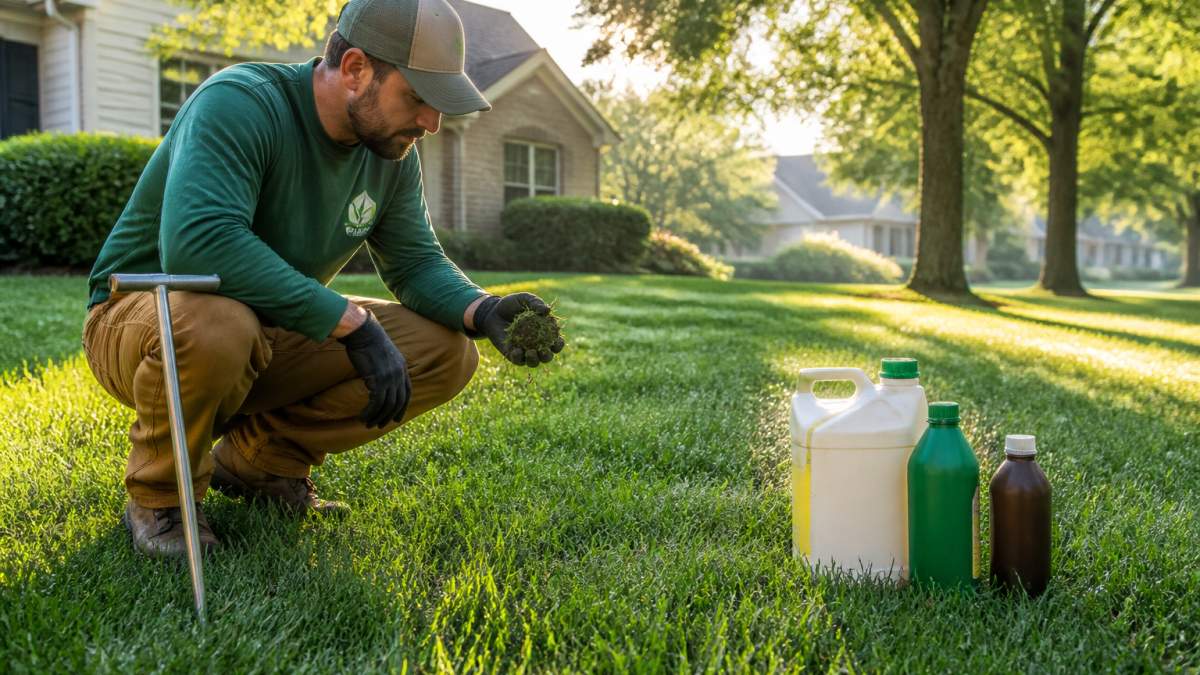
Chemical fertilizers feed grass immediately but leave soil biology unchanged or harmed. Organic fertilizers break down slowly, feeding microorganisms that build soil structure, water retention, and nutrient cycling, reducing dependence on repeated applications.
Eco-friendly methods require 6-8 weeks to show results; chemicals show results in days. For immediate needs, chemicals win. For long-term cost and resilience, eco-friendly approaches typically win.
Is Organic Lawn Care Effective?
Organic lawn care is effective, but effectiveness depends on your timeline. For immediate green-up, organic methods lose. For healthy, resilient turf requiring fewer inputs over time, organic methods win.
Organic fertilizers deliver nutrients slower than synthetics. Organic weed control requires more labor or different timing. Natural pest management reduces pests less dramatically or quickly than synthetic pesticides.
Your specific situation matters. Severe weed pressure may require aggressive action; healthy lawns thrive on organic approaches. Most homeowners fall somewhere in between.
Many practitioners find a hybrid approach works best: organic fertilizers as the foundation with targeted chemical intervention only for specific problems.
Organic lawn care works if you're willing to wait 6-8 weeks and commit to consistent applications. Heavily damaged lawns may need chemical intervention first, then transition to organic maintenance.
Natural Lawn Fertilizer vs Synthetic Fertilizer
The difference between natural and synthetic fertilizers comes down to how fast nutrients become available to your grass and what happens to your soil in the process.
Synthetic fertilizers deliver nutrients in soluble form that grass absorbs within days, greening up fast. However, nutrients are quickly depleted, requiring regular reapplication, and excess nutrients wash into groundwater and storm drains.
Natural fertilizers like compost, bone meal, and seaweed extract release nutrients slowly as soil microorganisms break them down, taking weeks. Nutrients stay longer in soil, feeding grass and microorganisms that improve structure. Over multiple seasons, soil becomes richer, water retention improves, and compaction decreases.
Synthetic fertilizers cost less per application but require frequent reapplication. Natural fertilizers cost more per bag but last longer. Over five years, total cost is often similar, but soil quality differs dramatically.
Choose based on your situation: healthy soil needing maintenance benefits from natural fertilizers; depleted soil or struggling grass benefits from synthetic fertilizers for faster recovery. Many providers recommend synthetic applications for immediate problems, then switch to natural fertilizers for maintenance.
| Fertilizer Type | Application Speed | Soil Impact | Reapplication Frequency | Best For |
|---|---|---|---|---|
| Synthetic | Results in 3-5 days | Temporary nutrient boost | Every 4-6 weeks | Quick green-up, problem lawns |
| Natural | Results in 4-8 weeks | Builds soil biology long-term | Every 6-8 weeks | Maintenance, soil health |
| Hybrid approach | Results in 2-3 weeks | Balanced nutrient and biology | Every 5-7 weeks | Most homeowners |
Environmental and Safety Impacts
Eco-friendly lawn care and chemical lawn care create different environmental footprints and pose different safety considerations for your family and pets.
Chemical treatments move through the environment predictably: excess fertilizer causes algae blooms, herbicides persist in soil and groundwater, and pesticides affect non-target species. Chemical residues on grass create exposure risks for children and pets, especially in the first 24-48 hours after application.
Safety depends on the specific chemical and application rates. Professional applicators using proper rates and timing create less risk than homeowner misapplication, but baseline risk exists since chemicals are designed to kill or alter biology without perfect discrimination.
Eco-friendly approaches eliminate most risks. Organic fertilizers move through soil slowly in forms soil biology can process. Mechanical weed control and natural pest management avoid chemical residues entirely, allowing immediate play for kids and pets.
The trade-off: eco-friendly methods require more labor and planning. You must scout for pests, intervene early, and accept some weeds as part of a balanced ecosystem.
Cost Comparison Over Time
The upfront cost difference between eco-friendly and chemical lawn care is real. Chemical treatments cost less per application. But the long-term cost picture is more complex.
Chemical applications cost less per treatment but require more frequent reapplication since effects don't build cumulatively.
Eco-friendly approaches cost more upfront but create cumulative benefits. After two years, soil biology improves and water retention increases, reducing application frequency. After three years, drought tolerance improves and weed pressure decreases, lowering irrigation and control costs.
Total cost over five years is often similar, but distribution differs: chemicals front-load savings; eco-friendly approaches build savings over time. Chemicals are cheaper for stays under three years; eco-friendly approaches become cheaper for longer stays.
Labor is a hidden cost. Eco-friendly approaches require more frequent scouting, hand-pulling, and monitoring. Professional eco-friendly lawn care handles this labor using state-of-the-art equipment to maintain your lawn without synthetic chemicals.
The total cost also depends on your lawn's starting condition and your goals. A severely degraded lawn may need chemical intervention first, that's an upfront cost you can't avoid. A healthy lawn that just needs maintenance can stay healthy on eco-friendly inputs from day one.
Organic Lawn Care Transition: How to Switch Methods
If you're currently using chemical treatments and want to transition to eco-friendly lawn care, the process takes planning but isn't complicated.
Year 1: Assessment and Foundation Building
Start by testing your soil. Most county extension offices offer affordable soil testing that tells you pH, nutrient levels, and organic matter content. This baseline helps you understand what your lawn actually needs rather than guessing.
Begin applying organic fertilizers on your existing schedule. Don't stop chemical treatments yet, just add organic applications. This lets your soil biology adjust gradually. After 6-8 weeks, you'll see how your lawn responds.
Weeks 1-4: Introduce Organic Fertilizer
Apply a balanced organic fertilizer (something like 5-5-5 or 6-4-3 NPK) to your entire lawn. Water thoroughly. You won't see dramatic results yet, that's normal.
Weeks 5-12: Monitor and Adjust
Scout your lawn weekly for weeds and pests. Note which problems emerge and when. This information guides your strategy going forward. If weed pressure is manageable, you're ready to reduce chemical herbicide use. If pest pressure spikes, you may need targeted intervention.
Year 2: Reduce Chemical Inputs
Once your soil has adjusted to organic fertilizers, reduce chemical applications by 50%. Use mechanical weed control (mowing at the right height, hand-pulling) and cultural practices (proper watering, aeration) instead of herbicides.
If specific pest or weed problems emerge, address them with targeted intervention, either organic options like neem oil or beneficial insects, or minimal chemical application only where needed.
Year 3 and Beyond: Full Transition
By year three, most lawns transition fully to organic fertilizers and eco-friendly pest management. Your soil biology has rebuilt. Your lawn's resilience has improved.
The timeline varies by lawn condition. A healthy lawn transitions in 12-18 months. A severely degraded lawn may take 24-36 months. Professional services can accelerate this timeline with proper aeration, targeted organic applications, and consistent monitoring.
Eco-Friendly Lawn Care Products and Practices
Eco-friendly lawn care relies on a different toolkit than chemical approaches. Understanding what's available helps you make informed choices.
Organic Fertilizers
Compost, aged manure, bone meal, blood meal, fish emulsion, seaweed extract, and plant-based fertilizers all feed your lawn while building soil. Each has different nutrient ratios and breakdown rates. A compost application works slowly but builds soil structure. Fish emulsion works faster but requires more frequent application. Most professionals use blended products that combine multiple sources for balanced nutrient delivery.
Mechanical Weed Control
Hand-pulling works for small areas and isolated weeds. For larger areas, mechanical cultivation (tilling the top inch of soil to uproot weeds) works well in spring and fall. Mowing at the correct height (2.5-3.5 inches for most grasses) suppresses weeds by shading the soil. Mulching prevents weed seeds from germinating.
Natural Pest Management
Beneficial insects like ladybugs and parasitic wasps control pest populations naturally. Neem oil and insecticidal soap address specific pest outbreaks without broad-spectrum toxicity. Removing pest habitat (thatch, standing water) prevents problems before they start.
Soil Improvement Practices
Core aeration relieves compaction and improves water penetration. Overseeding introduces vigorous grass varieties that outcompete weeds. Topdressing with compost adds organic matter and beneficial microorganisms. These practices address root causes rather than symptoms.
Water Management
Deep, infrequent watering encourages deep root growth and drought tolerance. Proper irrigation timing (early morning, avoiding evaporation) reduces water waste. Mulching retains soil moisture. These practices reduce your lawn's water needs significantly over time.
Which Approach Is Right for Your Lawn?
The honest answer depends on your priorities, your lawn's current condition, and your timeline.
Choose eco-friendly lawn care if:
You're thinking long-term. You value soil health and environmental impact. You're willing to wait 6-8 weeks for results. You have the budget for professional service or the time for hands-on management. You want to reduce chemical exposure for your family and pets.
Choose chemical lawn care if:
You need fast results. Your lawn is severely degraded and needs aggressive intervention. You want minimal labor and maximum convenience. You're less concerned about long-term soil health. You're in a rental or short-term situation.
Choose a hybrid approach if:
You want the best of both. Use chemical intervention for specific problems, then maintain with organic methods. Start with chemicals to fix immediate issues, then transition to eco-friendly maintenance. This balances speed, cost, and long-term health.
The reality is that most homeowners benefit from professional guidance. Your lawn's soil type, drainage, sun exposure, grass varieties, and pest/weed pressure are unique. A professional assessment from Lover's Lawn Services LLC can identify which approach, or which combination, will work best for your specific situation.
The choice between eco-friendly and chemical lawn care isn't about ideology. It's about matching your method to your goals, your timeline, and your lawn's actual condition.
Most homeowners discover that the "best" approach isn't one or the other, it's the one that fits their life and their values.
Frequently Asked Questions
What is the main difference between natural and chemical fertilizers?
Natural fertilizers release nutrients slowly as soil microbes break them down, while synthetic fertilizers provide fast-acting nutrients that plants absorb immediately. Natural options build soil biology over time, whereas chemical treatments deliver quick green-up but don't improve soil structure long-term. Natural fertilizers include compost, animal manure, and plant-based products; synthetics are manufactured compounds like urea and ammonium nitrate.
Is organic lawn care effective at fixing problem lawns?
Organic lawn care is effective, but results take longer than chemical treatments. Organic methods address root causes by improving soil health and biology, which creates resilient turf resistant to weeds and pests. Chemical treatments produce faster visible results, often within 1-2 weeks. For brown patches or thin turf, organic approaches typically show improvement within 4-8 weeks, depending on soil condition and climate.
Can you switch from chemical lawn care to organic methods?
Yes, you can transition from chemical to organic lawn care. The process typically takes 6-12 months as soil biology recovers and synthetic residues break down. During transition, your lawn may temporarily show weeds or slower growth as chemical dependency ends. Success requires consistent organic fertilizer applications, proper mowing height, and patience. Many homeowners see full results after one complete growing season.
Are chemical lawn treatments safe for pets and children?
Chemical treatments carry exposure risks. Synthetic pesticides and herbicides can affect pets through skin contact or ingestion of treated grass. Children playing on treated lawns may absorb chemicals through skin. Most manufacturers recommend keeping pets and children off treated areas for 24-48 hours after application. Eco-friendly lawn care eliminates this concern entirely, making it safer for households with young children or pets.
What eco-friendly lawn care products work best as alternatives to chemicals?
Top eco-friendly alternatives include organic fertilizers (compost, seaweed extract, fish emulsion), natural herbicides (acetic acid-based weed killers, clove oil), and beneficial microbes (mycorrhizae fungi, beneficial bacteria). Neem oil and insecticidal soaps handle pests naturally. These products avoid synthetic chemicals while still addressing lawn problems. Effectiveness varies by product and application, so choosing quality products and proper timing matters.