 How-to
7 Arlington Lawn Care Steps for a Healthier Yard
Last Updated: November 2, 2026
Quick Summary
Effective arlington lawn care starts with soil preparation, then follows a season-based maintenance schedule built around your grass species. Test and aerate the soil, water deeply and infrequently once established, and mow tall fescue at 3 to 3.5 inches, never removing more than one third of the blade.
- Arlington sits in the transition zone, so cool-season and warm-season grasses need separate schedules.
- September is the single best month for fescue aeration, overseeding, and fertilizing.
- Tall fescue needs light watering two or three times a day until germination.
- Pre-emergent applied in spring stops crabgrass before it sprouts.
- LawnGuru's Arlington listing shows lawn mowing starting at $44 as of October 2026.
Table of Contents
- Start With Soil Preparation Before Anything Else
- Build a Lawn Maintenance Schedule for Northern Virginia
- Seed, Water, and Fix Drainage Problems Early
- Mow, Trim, and Weed on the Right Frequency
- What Lawn Care Cost Looks Like and What Drives It
- How to Collect Lawn Care Service Quotes You Can Compare
- Reading Lawn Care Company Reviews Without Getting Fooled
- Book a Walkthrough With Lover's Lawn Services
- Frequently Asked Questions
Start With Soil Preparation Before Anything Else
Great arlington lawn care starts underground, not at the mower deck. According to the National Association of Landscape Professionals' landscape industry statistics, the landscaping market grew an average of 6.5% per year from 2020 through 2025, and much of that spending goes toward fixing lawns that were never set up correctly in the first place. At Lover's Lawn Services LLC, we see the same pattern on nearly every first visit: compacted soil, thin turf, and drainage that pushes water exactly where grass cannot survive.
Soil preparation is the foundation of every healthy lawn. Skip it and you will spend the rest of the season treating symptoms.
Test, Aerate, and Level the Ground
A soil test tells you the pH and nutrient levels before you spend a dollar on fertilizer. Northern Virginia soils tend toward heavy clay, which compacts easily and drains slowly. Core aeration pulls plugs from that layer and lets air, water, and roots move again. Level low spots at the same time so water stops pooling in the same corner every storm.
Build a Lawn Maintenance Schedule for Northern Virginia
A lawn maintenance schedule is a written plan that ties each task to the season, and it matters more here than in milder climates. Arlington sits in the transition zone, where cool-season grasses like tall fescue struggle through humid summers and warm-season grasses struggle through winter. One schedule cannot serve both.
The fix is to build the calendar around the species you actually have. Tall fescue needs its heavy feeding and seeding work in early fall. Bermuda and zoysia want their attention in late spring and summer. Get that split right and half your problems disappear.
A Month-by-Month Calendar for Arlington Yards
| Month | Primary Task | Why It Matters |
|---|---|---|
| March | Cleanup, first mow, soil test | Wake the lawn without tearing it |
| April | Pre-emergent weed control, light feeding | Stop crabgrass before it germinates |
| May | Raise mower height, spot weed | Shade out weeds as heat builds |
| June-August | Deep, infrequent watering | Push roots down, not up |
| September | Aerate, overseed, fertilize | The single best month for fescue |
| October | Leaf removal, final feeding | Prevent smothering and winter kill |
| November-February | Stay off wet turf, plan spring | Protect crowns from traffic damage |
Seed, Water, and Fix Drainage Problems Early
Lawn seeding fails for one reason more often than any other: the seed dries out in the first ten days. Tall fescue needs consistent moisture at the soil surface until germination, which means light watering two or three times a day rather than one long soak. Once the grass is established, flip the habit entirely and water deeply once or twice a week.
Drainage deserves equal attention. Water that stands for more than a day kills roots and invites disease. Watch where puddles form after a heavy rain and correct the grade before you seed again. Seeding into a wet, compacted spot wastes both seed and effort.
Mow, Trim, and Weed on the Right Frequency
Mowing frequency is often misunderstood, and the right answer depends on which grass you are cutting. The universal rule is simple: never remove more than one third of the blade at once. How that rule plays out week to week is where local lawns diverge.
Match Mowing Height and Frequency to Your Grass
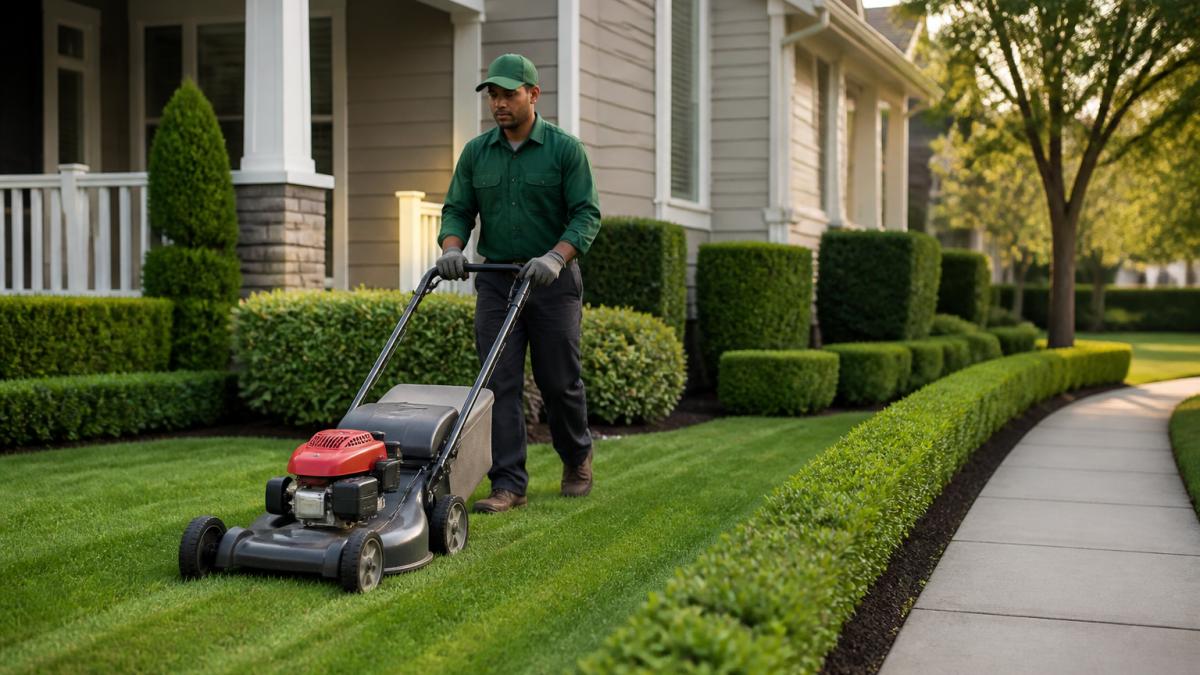
Tall fescue, the dominant cool-season turf on most local properties, performs best when kept at roughly 3 to 3.5 inches during the growing season. At that height the canopy shades the soil, keeps root crowns cooler in July, and crowds out crabgrass and other weeds that need light to germinate. In spring, when fescue is pushing growth, that usually means mowing every 5 to 7 days. In the slow heat of July and August, growth slows and a 10- to 14-day interval often keeps you inside the one-third rule.
Warm-season grasses behave differently. Bermuda and zoysia green up later and want a lower cut, commonly around 1 to 2 inches for Bermuda and 2 to 2.5 inches for zoysia, but they also spread aggressively and need more frequent cutting during their peak growth in late spring and summer. Cutting them at fescue height invites thatch buildup; cutting fescue at Bermuda height scalps it and opens the door to disease.
A common mistake is scalping the lawn on the first cut of spring to "clean it up." That single pass can set turf back by weeks, especially on fescue coming out of winter. Set the deck high for the first mow, then step it down gradually over two or three cuts.
Time Trimming and Weeding to the Same Visit
Trimming and weeding belong on the same visit as mowing, not on a separate trip. Edge the walkways, cut back growth around beds and fences, and pull weeds before they set seed. The timing matters: hand-pull or spot-treat broadleaf weeds like dandelion and plantain when the soil is moist and the weed is actively growing, because that is when the root comes up cleanly and when a targeted herbicide moves into the plant most effectively. Pulling dry, dormant weeds in August usually just snaps the top off and leaves the root to regrow.
For crabgrass and other annual grassy weeds, the fight is won in spring, not summer. Pre-emergent applied when soil temperatures approach the germination threshold stops the seed before it sprouts; once you see the weed, you are managing it, not preventing it. Keep mower blades sharp, a dull blade tears grass rather than cutting it, leaving ragged tips that brown and invite disease.
What Lawn Care Cost Looks Like and What Drives It
Lawn care cost in this market varies widely, and the drivers are predictable enough that you can estimate your own range before you call anyone. The biggest mistake homeowners make is comparing a bare mowing price against a full maintenance plan, they are not the same product, and the gap between them is usually larger than people expect.
Typical Price Ranges by Service Line
For a baseline, LawnGuru's Arlington listing shows lawn mowing starting at $44 as of October 2026, and that figure reflects basic mowing on a smaller, accessible lot, not full maintenance. In practice, most local homeowners see mowing priced per visit, with the per-visit rate falling as frequency rises. A weekly mowing plan usually costs more per month than a biweekly plan but protects turf better and often costs less per cut.
What Actually Moves Your Quote
- Lot size and access: Corner lots, steep grades, and fenced yards take longer per visit. A gate you have to open, a slope you cannot safely mow straight, or beds that need hand-trimming all add labor.
How to Collect Lawn Care Service Quotes You Can Compare
Arlington lawn care service quotes are only useful if they describe the same work. Ask every provider for a written scope covering frequency, what each visit includes, whether treatments are bundled or separate, and how they handle callbacks. Our step-by-step guide shows how to get an instant quote. An on-site estimate beats a phone quote every time because lot conditions vary so much.
The most common mistake is comparing a bare mowing price against a full maintenance plan. They are not the same product. Ask what happens after a storm, who handles leaf removal, and what the cancellation terms are.
Reading Lawn Care Company Reviews Without Getting Fooled
Lawn care company reviews reward careful reading. Look for patterns rather than single stars: do reviewers mention the same strength or the same failure repeatedly? A company with a 4.9 rating across hundreds of jobs is telling you something different than one with ten glowing reviews and no detail.
Watch for reviews that describe reliability specifically. "They showed up when they said they would" is the sentence that matters most in this trade. A local provider with consistent scheduling beats a cheaper one that misses appointments. Our own Arlington County green gardening guidance is also worth reading if eco-friendly practices matter to you, since it covers composting, native plants, and reduced fertilizer use.
Book a Walkthrough With Lover's Lawn Services
The fastest way to know what your yard needs is to have someone walk it with you. Lover's Lawn Services LLC has served 500+ local homes and holds a 4.9/5 rating on Google. Our approach is built on a Scandinavian-inspired, balanced outdoor aesthetic, with eco-friendly practices, state-of-the-art equipment, and a 100% satisfaction guarantee with a 3-day refund policy.
Frequently Asked Questions
How much does professional lawn care cost in Arlington?
Lawn care cost depends on lot size, service frequency, and whether you need treatments, seeding, or cleanup work. Pricing depends on lot size, service frequency, and the services included. For current prices, visit the Lover's Lawn Services LLC pricing page. Ask each provider for a written quote that itemizes mowing, edging, trimming, and any treatments so you can compare like for like.
How often should my lawn be mowed during the growing season?
Most Northern Virginia lawns need mowing every 7 to 10 days during peak growth in spring and early fall, moving to every two weeks in the slower heat of midsummer. The practical rule is to remove no more than one third of the blade height at a time. Keep the mower deck higher in summer to shade the soil and reduce stress. A weekly mowing schedule in spring protects turf health better than a single aggressive cut.
What should I ask a lawn care company before hiring?
Ask what the visit actually includes: mowing height, edging, trimming, blowing, and whether clippings are removed. Confirm the service frequency and what happens on rain days. Ask who performs the work and how complaints are handled. Get any guarantee and refund terms in writing. Request a lawn care service quote in writing and check recent lawn care company reviews for patterns in reliability, not just star ratings.
Is it better to hire a lawn care service or do it yourself?
Doing it yourself works if you have the time, the equipment, and the interest in learning soil and turf basics. Hiring makes more sense for busy households and for yards with drainage, weed, or disease problems that need consistent attention. A short trial period is a fair way to test a provider.
Your lawn has probably been telling you what it needs for a while, and a walkthrough turns that into a plan. Get started with Lover's Lawn Services LLC and a yard that looks intentional in every season.