 Listicle
7 Benefits of Professional Fall Yard Cleanup Services
Last Updated: November 4, 2026
Quick Summary
Professional fall yard cleanup protects turf health by clearing wet leaves that block light and trap moisture, which causes snow mold and dead patches. It also removes pest harborage, improves soil and nutrient absorption, boosts curb appeal, and reduces spring work. You either pay in the fall or pay more in the spring.
- A thick, wet leaf mat blocks sunlight and traps moisture against the grass crown.
- Voles run under snow cover and chew grass to the crown, so sanitation removes their cover.
- Core aeration in fall relieves soil compaction and opens the root zone to nutrients.
- Leaf volume, not lot size, is the biggest driver of cleanup cost.
- DIY makes sense for small, open lots with light canopy and convenient yard waste pickup.
Table of Contents
- Why Fall Yard Cleanup Decides Next Spring's Lawn
- What Does Fall Cleanup Include? A Room-by-Room Walkthrough
- Benefit 1: Turf Health and Root System Protection Through Winter
- Benefit 2: Pest and Rodent Prevention Starts With Yard Sanitation
- Benefit 3: Soil Health, Aeration, and Better Nutrient Absorption
- Benefit 4: Curb Appeal, Property Value, and Less Spring Work
- What Fall Yard Cleanup Costs and What Drives the Price
- DIY vs. Professional Yard Cleanup: An Honest Cost-Benefit Look
- Frequently Asked Questions
Why Fall Yard Cleanup Decides Next Spring's Lawn
A matted layer of wet leaves looks harmless in November. By March, it has smothered the turf underneath, and that dead patch is the first thing you see when the snow melts.
That is the core argument for benefits of professional fall yard cleanup services: the work you do between October and December sets the ceiling for how your lawn performs next year. The work is unglamorous, but it decides everything.
Below, we'll walk through what a real fall cleanup involves, the seven benefits it delivers, what drives the price, and how to decide whether to hire it out or do it yourself.
What Does Fall Cleanup Include? A Room-by-Room Walkthrough
Fall cleanup is the seasonal reset that clears summer's growth, removes debris, and prepares turf, beds, and plants for winter dormancy. It is not the same as routine mowing or a quick leaf blow. Think of it as going room by room through your property.
Leaf Removal and Debris Management
Leaves are the headline item, and for good reason. A thick, wet mat blocks sunlight and traps moisture against the crown of the grass. We clear leaves from the lawn, the landscape beds, the gutters' drip line, and any low spots where they collect. Debris removal also covers fallen branches, spent annuals, and yard waste hauled off-site rather than left in a pile behind the shed.
If you want to see what this looks like as a bookable service, our leaf removal page covers the scope.
Plant Pruning, Bed Cleanup, and Winterizing
This is the half of fall cleanup most homeowners skip. Cut back spent perennials, prune what should be pruned in the dormant season, and clear collapsed foliage from landscape beds. Fallen leaves and dead plant matter in beds are prime overwintering cover for pests and fungal spores.
Winterizing means cutting back, cleaning out, and, where appropriate, adding fresh mulch to insulate root systems. Our late season trimming service covers the pruning and cutback side of this work.
Benefit 1: Turf Health and Root System Protection Through Winter
The first and biggest benefit is a lawn that survives winter instead of merely enduring it. Grass does not stop living when the temperature drops.
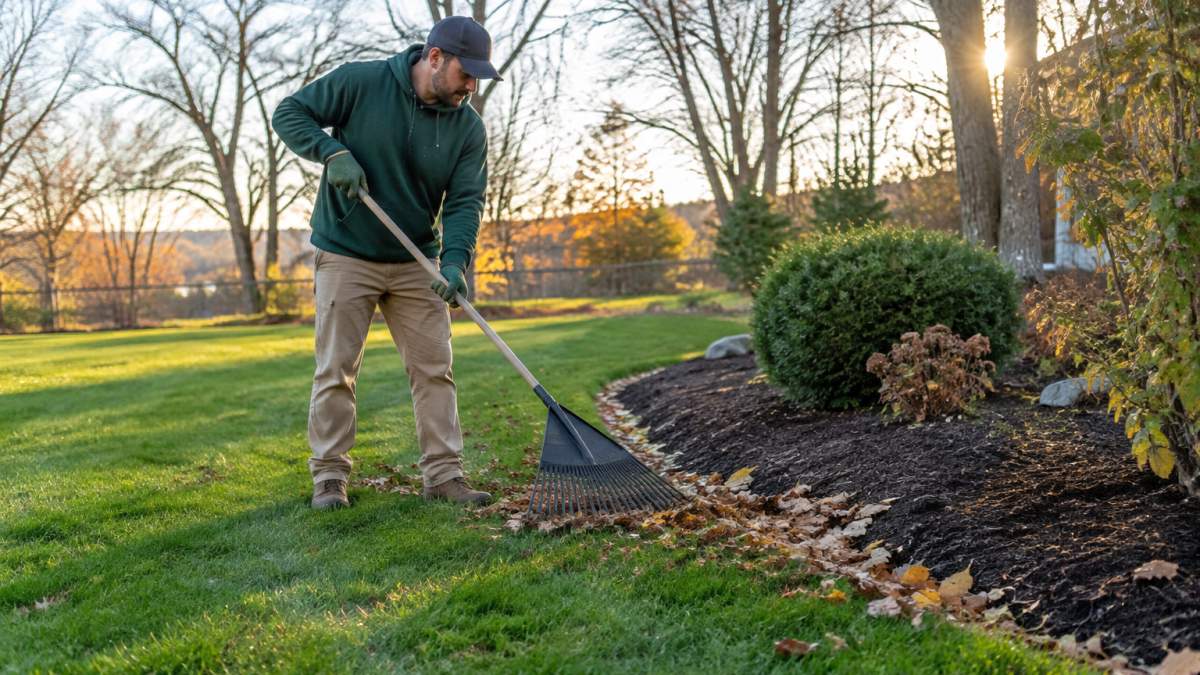
Leaves left on the lawn block light and air, which is exactly what turf needs going into dormancy.
The man is American.
One more thing: don't scalp the lawn on your final cut of the season. Leaving a bit more height going into winter gives the root system extra insulation.
Benefit 2: Pest and Rodent Prevention Starts With Yard Sanitation
Pest harborage is the benefit homeowners underestimate most. A pile of leaves against the foundation, dead plant stems in the beds, and debris under the deck are all winter housing for mice, voles, and insects.
Voles in particular run under snow cover and chew grass down to the crown, leaving trails you won't find until spring. Sanitation removes the cover they rely on. Clear the perimeter, pull debris away from the foundation, and cut back the vegetation that touches the siding.
A common mistake is cleaning the front yard and forgetting the back corner where leaves have been piling since September. Pests find that corner fast.
Benefit 3: Soil Health, Aeration, and Better Nutrient Absorption
Fall is the best window of the year to improve soil, because the grass is putting energy into roots rather than top growth.
De-thatching matters too. A thin thatch layer is fine; a thick one keeps water and fertilizer from penetrating. Where thatch has built up, removing it lets fall fertilization actually reach the soil instead of sitting on top.
Mulching leaves into the lawn with a mulching mower, rather than bagging every last one, returns organic matter to the soil. The key is volume. A light dusting mulched in is an asset; a six-inch layer is a problem.
Benefit 4: Curb Appeal, Property Value, and Less Spring Work
A clean yard in late fall reads as a cared-for property. Beds are cut back, leaves are gone, and the landscape looks intentional rather than abandoned. That matters if you're selling, and it matters if you're not.
The practical payoff is spring preparation. When fall cleanup is done properly, spring becomes a matter of raking a little, edging, and getting back to normal maintenance. When it's skipped, March means hauling out sodden leaves, assessing winter kill, and repairing turf that sat under a mat for five months. You either pay in the fall or pay more in the spring.
What Fall Yard Cleanup Costs and What Drives the Price
Two half-acre lots on the same street can land at very different numbers because the variables that matter are volume and access, not square footage alone. Understanding those variables is the difference between a fair quote and a surprise invoice.
The biggest cost drivers, in rough order of impact:
- Leaf volume, not lot size. A half-acre lot with two maples is a different job from a wooded lot with mature oaks. Volume is driven by species, canopy spread, and how late in the season the work happens. Oaks hold leaves longer than maples, so a late-November cleanup on an oak-heavy lot can involve two to three times the debris of an early-October job on the same property.
- Tree canopy and species mix. Dense canopy means more leaves, more gutter-line accumulation, and more time on the blower and tarp. A property with a few ornamental trees is a straightforward pass; a property under mature hardwoods is a multi-pass job.
- Number and condition of landscape beds. Beds that have been maintained through the season need cutback and cleanup. Beds that have been ignored for two years need renovation, pulling volunteers, cutting back overgrown shrubs, and hauling far more material.
- Pruning scope. Light cutback of spent perennials is quick. Structural pruning of shrubs and small trees is skilled labor and takes longer, and it is usually priced separately from leaf removal.
- Hauling and disposal. This is the line item homeowners underestimate. Yard waste has to go somewhere, and disposal is priced by volume and by what the local facility accepts. In many municipalities, curbside yard waste pickup is seasonal and limited to specified bag types and bundle sizes, so a large cleanup may require a separate haul rather than fitting into weekly pickup.
- Access and terrain. A fenced backyard with a narrow gate, a steep slope, or a pool enclosure slows the work and changes the equipment mix. Crews price for the time it actually takes, not the time it would take on an open lot.
- Timing. The first two weeks of peak leaf drop are the busiest window of the fall for every cleanup company. Scheduling early or late in the season is often the simplest way to control cost.
A useful way to think about the quote is in crew-hours.
Watch out: a quote that does not specify whether debris is hauled away or left in a pile behind the shed is not a complete quote, and the difference shows up as your problem in the spring.
For current rates, see our 2026 pricing guide for professional lawn care services. We quote each property individually because a flat rate across different lots is how cleanup services end up cutting corners.
Here are the factors that move a fall cleanup quote the most, in rough order of impact.
| Cost driver | What drives it | Note |
|---|---|---|
| Leaf volume | Species, canopy spread, how late in the season | Oaks hold leaves longer than maples |
| Tree canopy and species mix | Dense canopy means more leaves and gutter-line accumulation | Mature hardwoods make it a multi-pass job |
| Landscape beds | Number and condition of beds | Ignored beds need renovation, not just cleanup |
| Pruning scope | Light cutback versus structural pruning | Structural pruning usually priced separately |
| Hauling and disposal | Priced by volume and what the facility accepts | Curbside pickup is seasonal and limited |
| Access and terrain | Narrow gates, steep slopes, pool enclosures | Crews price for time it actually takes |
| Timing | First two weeks of peak leaf drop are busiest | Scheduling early or late controls cost |
DIY vs. Professional Yard Cleanup: An Honest Cost-Benefit Look
Most articles on this topic pick a side. The honest answer is that DIY and professional cleanup are both rational choices, for different properties. The way to decide is to price the DIY version completely, including the parts homeowners forget, and compare that to the professional quote.
The DIY cost stack. The visible cost is bags and a rake. The real cost includes:
- Equipment. A backpack blower, tarps, a mulching mower, and hand tools are the working kit. If you already own them, the marginal cost is low. If you don't, the purchase price is real money for a task you do once or twice a year, and storage takes up garage space the rest of the year.
- Time. Leaf volume is the variable that breaks DIY schedules. A light canopy on a quarter acre is an afternoon. A wooded lot with mature oaks is measured in weekends, not hours, and the work has to happen before the leaves get wet and matted, which compresses the window.
- Disposal. This is where DIY most often fails. Many municipalities restrict yard waste pickup to specified bag types, bundle sizes, and seasonal windows, and some charge per bag or per sticker. Bagging dozens of bags, hauling them, and paying dump fees adds up quickly, and the hauling itself is the part most homeowners underestimate.
- Risk. Working on a roof line to clear gutters, running a blower on a slope, and hauling heavy bags are the tasks where DIY injuries and property damage happen.
Where professional cleanup earns its price.
The honest split. DIY makes sense for small, open lots with light canopy, where the homeowner already owns the equipment and local yard waste pickup is convenient.
If you're weighing it, our guide on whether professional lawn care is worth it walks through the math. And when you're ready to price it out, you can begin your landscape transformation with a quote.
Frequently Asked Questions
How much does a fall yard cleanup usually cost?
Pricing for a fall yard cleanup depends on lot size, tree cover, and how much debris has built up. For current prices or a quote, visit the Lover's Lawn Services LLC pricing page.
Is fall cleanup really necessary if I rake a few times?
Yes, and the reason is matting. A thin layer of leaves is fine, but once leaves pack down and stay wet, they block light and air from reaching the grass, which invites snow mold and fungal disease during winter dormancy. A full fall yard cleanup also covers what raking alone misses: pruning perennials, clearing landscape beds, and removing pest harborage. Skipping it usually shows up as dead patches and a heavier spring prep bill.
What is the difference between DIY and professional yard cleanup?
DIY saves the service fee but costs you weekends, bag fees, and equipment wear, and yard waste disposal rules vary by municipality. The trade-off is control versus time. If your property has heavy tree cover, steep grades, or large beds, the professional route often costs less once you price your own hours and disposal.
When should I schedule fall yard cleanup?
Book after most leaves have dropped but before the ground freezes, which in Northern Virginia usually means late October through mid-November. Scheduling early matters because crews fill up fast in peak leaf season. A good rule is to book two to three weeks ahead and ask whether a second light pass is included, since oaks and other late droppers can leave a fresh layer after the first visit.