 Ultimate guide
The Facility Manager's Guide to Effortlessly Maintained Outdoor Environments
Last Updated: November 10, 2026
Quick Summary
Clean, balanced, and effortlessly maintained outdoor environments for facility management come from treating grounds as a planned system: a written seasonal calendar, a scoped vendor agreement with inspection triggers, and low-maintenance design. Effortless is a design and scheduling outcome, not a maintenance miracle, so properties that look calm year-round have documented schedules and measurable vendor oversight behind them.
- Map inspections, maintenance planning, and service visits to the months each task matters in a seasonal calendar.
- Mowing too low in summer to stretch visit intervals stresses turf and invites weeds.
- Write visit frequencies and inspection triggers into the vendor agreement, not a shared understanding.
- Tie contract payment to inspection scores and response times rather than per-visit counts.
- Track work-order response time, inspection completion rate, water use, cost per area, and safety incidents.
Table of Contents
- Why Outdoor Environments Belong in Your Facility Management Plan
- Commercial Landscaping Best Practices That Hold Up Year-Round
- Sustainable Facility Maintenance Strategies for Grounds and Water Systems
- The Benefits of Professional Groundskeeping for Occupants and Operations
- Building a Seasonal Maintenance Calendar for Outdoor Spaces
- Low-Maintenance Landscape Design and Lifecycle Budgeting
- Vendor Oversight, Accessibility, and Measuring Outdoor Performance
- Booking a Grounds Assessment for Your Property
- Frequently Asked Questions
Why Outdoor Environments Belong in Your Facility Management Plan
A growing share of facility management spend now flows to the grounds outside the building. Clean, balanced, and effortlessly maintained outdoor environments for facility management are no longer an afterthought to indoor operations.
Grounds work is best treated as a system: turf, trees, hardscape, drainage, and water features all affect how a property performs. A 2026 facility management trends report describes the shift from reactive to data-driven operations reshaping hygiene, labor, and sustainability strategies.
That shift matters because outdoor neglect is expensive. Overgrown beds block sightlines, clogged drains crack pavement, and patchy turf signals a property nobody is watching.
What Clean, Balanced, and Effortless Actually Mean
Clean means defined edges, clear walkways, and no debris or weed pressure at transitions. Balanced means plantings, turf, and hardscape read as one intentional composition rather than separate zones. Effortless means the property looks cared for without a constant scramble of emergency calls.
In practice, effortless is a design and scheduling outcome, not a maintenance miracle. Properties that look calm year-round are usually the ones with a written calendar and a scoped vendor agreement behind them.
Commercial Landscaping Best Practices That Hold Up Year-Round
The best commercial landscaping best practices share one trait: they are boring on purpose.
A common mistake is mowing too low in summer to stretch the interval between visits. That stresses turf, invites weeds, and costs more to fix than the visit saved. We would rather cut slightly higher and more often.
For facility managers building a program from scratch, a commercial landscaping checklist gives you a practical starting structure for inspections, seasonal tasks, and vendor expectations.
Sustainable Facility Maintenance Strategies for Grounds and Water Systems
Sustainable facility maintenance strategies start with resource efficiency: right-plant-right-place design, reduced irrigation demand, and equipment that does not waste fuel or water. A peer-reviewed study on sustainable facilities management examines how facilities management practice in the built environment has expanded to include sustainability principles as a core function.
Green practices also reduce risk. Native and adapted plantings need less chemical input, which lowers runoff concerns near storm drains and parking areas.
Water Quality, Cooling Towers, and Closed-Loop Systems
Water systems deserve their own line in the plan. Cooling towers, boilers, closed-loop systems, and hot water systems all depend on chemically balanced water to protect equipment reliability and control biological growth. Poorly managed water is a maintenance cost and a health concern at once.
Outdoor water features and irrigation tie into the same discipline. Inspect for standing water, check backflow devices, and keep drainage swales clear so stormwater moves where it should.
The Benefits of Professional Groundskeeping for Occupants and Operations
The benefits of professional groundskeeping reach further than curb appeal. Well-maintained environments support occupant comfort, encourage walking and outdoor breaks, and shape how visitors judge a property before they reach the door.
Nearly 60% of facility management professionals surveyed in 2026 reported that they do not currently have the systems or data to fully optimize their repair and maintenance workflows, according to Ecotrak's 2026 state of facilities management report.
Consistent upkeep also supports safety and risk reduction: clear walkways, safe surfaces, and trimmed sightlines reduce trip hazards and liability exposure.
Building a Seasonal Maintenance Calendar for Outdoor Spaces
A seasonal maintenance calendar is the single document that turns good intentions into consistent upkeep.
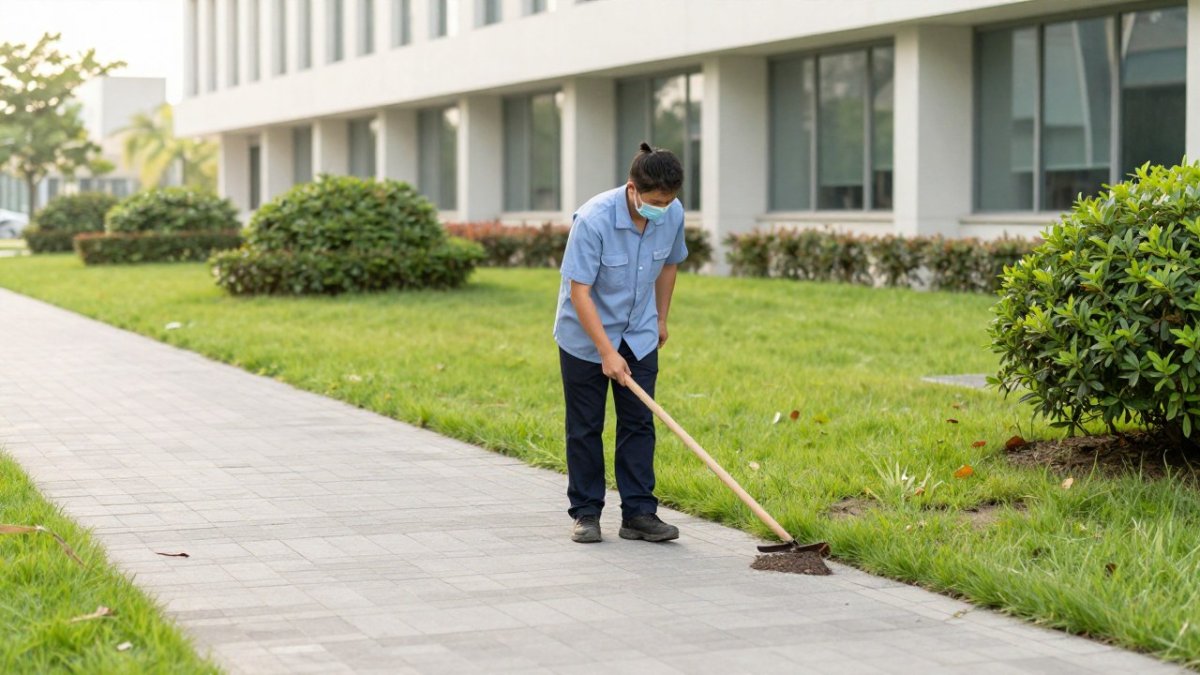
Here is one way to structure a year for a commercial property in a four-season climate. Adjust the shoulder months for your growing zone, but keep the sequence.
| Month | Core Tasks | Inspection Trigger |
|---|---|---|
| January | Snow and ice response, de-icing, equipment service, dormant pruning of structural trees | Check for ice dams at downspouts and ponding at drain inlets after each melt |
| February | Same as January plus bed line touch-up and hardscape walk for heaved slabs | Photograph any trip hazard over 1/4 inch |
| March | Irrigation startup and backflow test, first cleanup, pre-emergent application, mulch refresh begins | Verify zone-by-zone coverage before turf breaks dormancy |
| April | Mowing begins at higher cut height, edging, weed control, spring fertilizer, bed cleanup finish | Walk every transition edge; note weed pressure at bed-to-turf lines |
| May | Weekly mowing, irrigation audit, seasonal color install, drainage swale clearing | Check for standing water 24 hours after rain |
| June | Mowing, edging, spot weed control, irrigation checks, tree and shrub pest scouting | Measure turf density in high-traffic zones |
| July | Mowing at raised height, deep irrigation cycles, mulch top-off, hardscape sweep | Inspect for drought stress and irrigation overspray on pavement |
| August | Mowing, aeration scheduling, overseeding prep, storm drain clearing | Confirm drainage inlets are clear before fall rains |
| September | Aeration and overseeding, fall fertilizer, leaf removal begins, irrigation reduction | Check seed-to-soil contact and germination in thin areas |
| October | Leaf removal, drainage clearing, bed cleanup, irrigation blowout scheduling | Inspect swales and catch basins after first heavy leaf drop |
| November | Final leaf removal, irrigation blowout, snow contract activation, equipment winterization | Confirm snow response times and de-icing material storage |
| December | Snow and ice response, de-icing, winter pruning, equipment service | Review season work orders and adjust next year's scope |
Two programs anchor the calendar: a seasonal lawn care plan for turf health and snow removal coverage for winter safety. The calendar is only useful if it is written into the vendor agreement with visit frequencies and inspection triggers, not left as a shared understanding.
Low-Maintenance Landscape Design and Lifecycle Budgeting
Low-maintenance landscape design is the cheapest long-term decision a facility manager can make. Fewer moving parts, adapted plantings, and hardscape that tolerates freeze-thaw cycles all cut labor hours and replacement costs over a property's lifecycle.
Our landscaping services are built around this idea, with a Scandinavian-inspired approach that favors clean lines, balanced plant masses, and restrained color over high-churn seasonal displays.
What Outdoor Maintenance Really Costs Over Time
Outdoor maintenance costs are driven less by the per-visit rate than by what you replace. A design that needs annual replanting, constant irrigation repair, or repeated patching costs far more across five years than a simpler scheme with a higher upfront design fee.
In a 2026 survey of facility management professionals, 59% identified the cost of implementing new cleaning technology as a significant barrier, according to Cleaning & Maintenance Management's 2026 in-house survey. The same budget tension applies to grounds equipment.
Vendor Oversight, Accessibility, and Measuring Outdoor Performance
Vendor oversight separates a managed property from a hopeful one. Scope the contract around measurable outcomes, set inspection schedules, and require documentation of work orders so service quality is verifiable rather than assumed.
Accessibility belongs in that scope. Walkway grades, curb ramps, cross slopes, and clear paths of travel are part of the physical environment, and grounds crews are often the first to notice a blocked route or a heaved slab.
A 2026 study on safety management in outsourced facility management examines the practices and challenges of safety management when services are outsourced, a useful frame for how you write and enforce vendor safety expectations. For contract structure, these commercial lawn maintenance contract tips help property managers set clear terms before signing.
Measure performance with numbers you can compare month to month. Five that hold up:
- Work-order response time, hours from report to on-site arrival, tracked by priority tier.
- Inspection completion rate, percentage of scheduled inspections actually performed and documented.
- Water use, gallons per irrigated acre per month, compared against the prior year.
- Maintenance cost per area, annual grounds spend divided by maintained square footage, which lets you compare zones and years.
- Safety incidents, trip, slip, and fall reports tied to outdoor surfaces, plus near misses.
Add inspection scores for turf density, weed pressure, and hardscape condition, and review them with the vendor on a fixed cadence.
Booking a Grounds Assessment for Your Property
Most outdoor problems are visible months before they become expensive. A grounds assessment walks the property, scores each zone, and produces a prioritized task list you can budget against.
Lover's Lawn Services LLC offers Scandinavian-inspired lawn care and landscaping with eco-friendly practices and state-of-the-art equipment. We back the work with a 100% satisfaction guarantee and a 3-day refund policy, and we have served 500+ local homes with a 4.9/5 Google rating.
Get started with Lover's Lawn Services LLC and turn your grounds into a documented, seasonal plan instead of a recurring surprise.
Frequently Asked Questions
What are the four P's of facility management?
The four P's are people, process, place, and performance. People covers occupants and the staff who maintain the site. Process is the work orders, inspection schedules, and maintenance planning that keep building systems running. Place is the physical environment, indoors and out. Performance is how you measure results, from equipment reliability to service quality. Outdoor environments sit inside the place and process pillars, which is why grounds work belongs in the same plan as HVAC and cleaning rather than in a separate contract nobody reviews.
How does professional groundskeeping affect workplace productivity?
Well-maintained environments shape how people read a property before they walk in. Clean walkways, safe surfaces, and consistent upkeep signal that the building is cared for, and that perception carries into how occupants and visitors rate the site. The benefits of professional groundskeeping also show up operationally: crews on a fixed inspection schedule catch drainage problems, trip hazards, and failing irrigation before they become work orders. That said, treat productivity gains as a reasonable expectation from better occupant comfort and safety, not a guaranteed percentage.
What defines a balanced outdoor environment in a commercial setting?
Balance means the landscape looks intentional rather than overgrown or stripped bare. In practice that means plantings sized to their space, turf that is healthy without constant chemical intervention, surfaces that drain, and a maintenance rhythm that keeps edges, beds, and walkways consistent from month to month. It also means the outdoor plan matches how the property is actually used, so a courtyard gets seating and shade while a service entrance gets durable groundcover and clear access. Balance is a design and scheduling decision, not a one-time cleanup.
How can facility managers keep outdoor environment quality consistent?
Consistency comes from written standards and a seasonal calendar, not from hoping a contractor shows up. Define what acceptable looks like for mowing height, bed edges, litter pickup, and snow or leaf response, then tie payments to documented visits and photos. Even a simple work order log and inspection schedule gives you a clearer picture of grounds performance. Review service quality quarterly and adjust the calendar before problems repeat.
What are the benefits of eco-friendly practices in commercial outdoor maintenance?
Eco-friendly grounds care reduces chemical runoff into storm drains and local waterways, improves soil health so turf needs less water, and lowers the risk of exposing occupants and pets to freshly treated surfaces. It also aligns with the shift toward green cleaning and sustainability that facility priorities moved toward in 2026. The practical test is whether the approach still solves the problem: a brown patch that resisted repeated treatments often points to causes such as soil compaction, drainage, or irrigation coverage that need to be assessed.
Why is intentional landscaping important for modern facility management?
Intentional landscaping turns outdoor space into an asset with a defined purpose and a budget line. Instead of replacing whatever dies each spring, you plan plantings for the site's light, soil, and traffic, set a lifecycle replacement schedule, and track outdoor maintenance costs against that plan. This is how clean, balanced, and effortlessly maintained outdoor environments stay that way after the first season. It also supports space utilization, since a well-planned courtyard or entry plaza gives occupants usable outdoor space rather than a bed of mulch nobody sits near.