 Ultimate guide
Commercial Lawn Maintenance Contract Tips for Property Managers
Last Updated: October 29, 2026
Quick Summary
A commercial lawn maintenance contract is a written agreement that defines the work performed, how often it happens, the price, and the conditions that apply. Its main job is to close three gaps: undocumented scope, assumed frequency, and unagreed change terms. Writing these down before work begins prevents most disputes.
- Attach a labeled site plan so zone boundaries are never guesswork.
- Require the contractor to carry liability and workers' compensation insurance and name the owner as additional insured.
- Ask for an itemized estimate before signing, since a bid far below the others usually omits a line.
- Convert every quote to the same pricing unit before comparing bids.
- Document any additional work in a written change order approved before it is performed.
Table of Contents
- Defining Scope of Work and Service Specifications
- Commercial Lawn Care Pricing and Estimating Methodology
- Key Contract Terms and Conditions to Include
- Commercial Landscaping Contract Template Essentials
- Site Assessment, Service Standards, and Performance Tracking
- Commercial Landscaping Services Checklist and Next Steps for Your Property
- Frequently Asked Questions
Commercial lawn maintenance is a growing business. The global grounds services market is projected to grow from USD 357.2 billion in 2026 to USD 639.8 billion by 2036 (Prestonwood Landscape's Commercial Landscape Contracts guide).
A commercial lawn maintenance contract is a written agreement that defines what work will be performed, how often, at what price, and under what conditions. It protects both the property manager and the contractor.
The U.S. lawn care market is valued at USD 62.91 billion in 2026 and is forecast to reach USD 82.67 billion by 2032 (Mordor Intelligence's United States Lawn Care Market analysis). A market this size rewards businesses that operate on documented terms rather than informal understandings.
Most disputes trace back to one of three gaps: the scope was never written down, the frequency was assumed, or the terms for changes were never agreed. A well-drafted contract closes each gap before work begins. It turns a relationship built on memory into one built on shared records.
Defining Scope of Work and Service Specifications
The scope of work is the single most important section of any commercial lawn maintenance contract. It lists every task included, the areas where it applies, and the standard to which it must be performed.
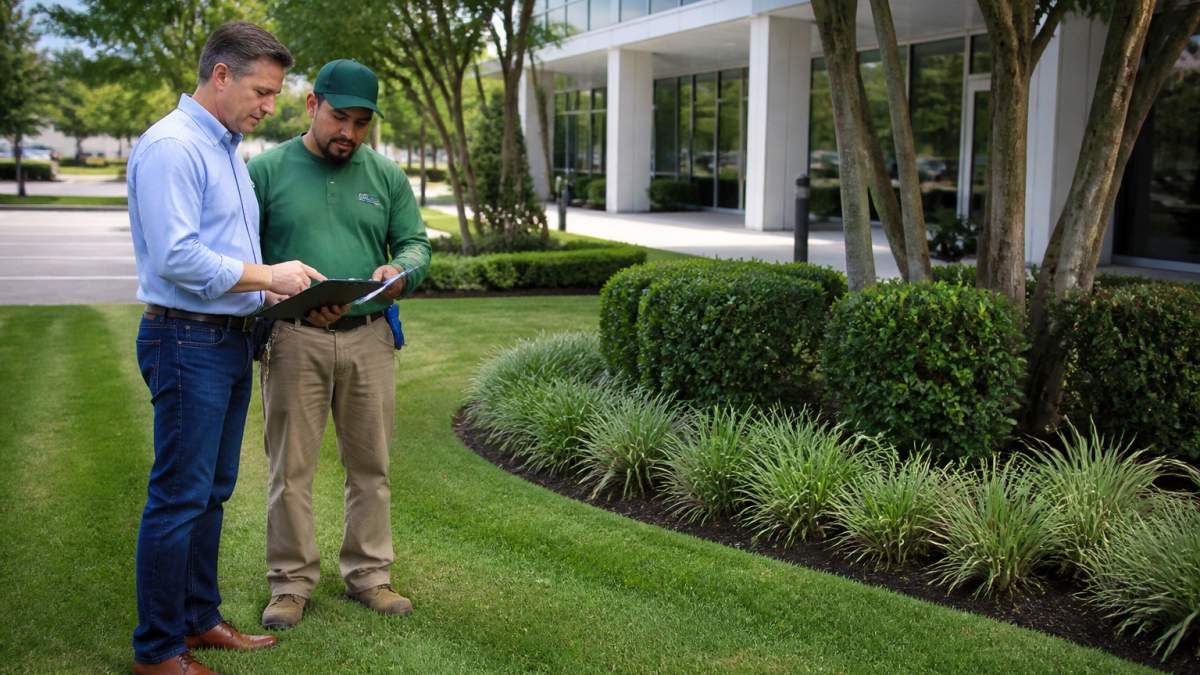
Vague language is the enemy here. "Mow the lawn" invites argument. "Mow all turf areas on the north, south, and east lots at a height of 3 inches, with clippings removed from paved surfaces" leaves little room for interpretation.
Service specifications should cover:
- Mowing height and frequency for each zone
- Edging, trimming, and blowing of hard surfaces
- Bed maintenance, weeding, and mulch replacement
- Fertilization and pest control, if included
- Seasonal cleanup and leaf removal
- Snow removal, if the property requires it
Watch out: listing an area without a map or site diagram attached is one of the most common causes of scope disputes. Attach a labeled site plan so zone boundaries are never guesswork.
Commercial Lawn Care Pricing and Estimating Methodology
Pricing depends on property size, service frequency, the number of visits, labor requirements, equipment, materials, and travel. Readers can review current pricing and request a quote directly from the Lover's Lawn Services LLC pricing page.
Large homeowners associations and master-planned communities typically budget USD 50,000 to USD 400,000 per year for landscape maintenance (United Land Services' 2026 commercial landscape maintenance budget guide). That range reflects property scale, not a universal contract price, so use it only as a rough planning reference.
A transparent estimate itemizes labor hours, equipment costs, materials, overhead, travel, and a stated margin. Contractors often target a margin of 20 to 30 percent on full maintenance contracts, according to FieldCamp's guidance on pricing commercial lawn care jobs (FieldCamp's guide to pricing commercial lawn care jobs).
Building an Estimate Line by Line
A practical estimating method starts with the visit, not the season. For each service zone, estimate the crew hours per visit, then multiply by the number of visits in the contract term.
- Labor. Multiply crew hours per visit by the loaded hourly rate (wage plus payroll taxes and benefits). A two-person crew spending 1.5 hours per visit at a loaded rate of USD 35 per person-hour costs USD 105 per visit.
- Equipment. Assign an hourly equipment cost for mowers, trimmers, blowers, and the truck that pulls them.
- Materials. Add fertilizer, seed, mulch, and pest-control products at cost plus a handling markup. Materials should be listed separately so the client can see what is being applied and when.
- Travel and disposal. Include drive time between accounts and the cost of hauling clippings or debris, especially for properties that require removal rather than mulching.
- Overhead. Allocate a share of insurance, office staff, software, fuel, and vehicle costs.
- Margin. Apply the target margin last, on top of fully loaded cost, so the contract remains profitable if a visit runs long.
Illustrative Estimate
The exact numbers will vary by market, but the structure of an itemized estimate is what makes it defensible.
Pricing Units to Compare
Quotes can be compared on different units, and mixing them up causes confusion. Common units include:
- Per visit: useful for mowing and routine turf care.
- Per month: common for full-maintenance contracts billed evenly across the year.
- Per acre or per 1,000 square feet: useful for large turf areas and for comparing bids on different properties.
- Per application: standard for fertilization and pest control.
- Per event: used for seasonal cleanups and snow removal.
When comparing bids, convert every quote to the same unit. A per-visit price that looks low can be more expensive than a per-month price once the visit count is included.
The article breaks a transparent estimate into six line items, each built from the same visit-level inputs.
| Estimate line | How it is calculated | Note |
|---|---|---|
| Labor | Crew hours per visit × loaded hourly rate | Two-person crew at 1.5 hours and USD 35 per person-hour costs USD 105 per visit |
| Equipment | Assigned hourly cost for mowers, trimmers, blowers, truck | Hourly equipment cost is assigned per visit |
| Materials | Fertilizer, seed, mulch, pest control at cost plus markup | Listed separately so the client sees what is applied and when |
| Travel and disposal | Drive time between accounts plus hauling costs | Matters most where debris is removed rather than mulched |
| Overhead | Share of insurance, office staff, software, fuel, vehicles | Allocated as a share of total costs |
| Margin | Target margin applied last, on fully loaded cost | Contractors often target 20 to 30 percent on full maintenance contracts |
Key Contract Terms and Conditions to Include
Beyond scope and price, a strong contract allocates risk and defines how the relationship operates when something goes wrong.
Insurance and certificates. Require the contractor to carry general liability coverage and workers' compensation, and to name the property manager or owner as an additional insured.
Indemnification. An indemnification clause states who pays if a third party is injured or property is damaged.
Property damage and turf damage. Define what counts as damage versus normal wear.
Dispute resolution. Choose a mechanism before a dispute exists: informal negotiation first, then mediation, then arbitration or litigation.
Payment schedule and late fees. State the invoicing cadence, the payment due date, and the late fee or interest rate.
Change orders. Define how additional work is requested, priced, and approved in writing before it is performed.
Service guarantee. State precisely what the contractor will correct if work does not meet the specification, within what timeframe, and what the client must do to invoke it. Our article on what a lawn care guarantee should cover explains what to expect.
Commercial Landscaping Contract Template Essentials
A usable template is short enough to read and complete enough to enforce. Include these sections in a standard commercial landscaping contract template:
- Parties and property address
- Scope of work with attached site plan
- Service schedule by month
- Pricing and payment terms
- Change order procedure
- Insurance requirements
- Termination and renewal clauses
- Signatures and dates for both parties
"Agreement is hereby made between [Contractor Name] and [Property Manager Name] for the maintenance of [Property Address] per the scope, schedule, and pricing in Exhibits A through C."
Fill in every bracket before signing. Blank fields are where disputes start.
Site Assessment, Service Standards, and Performance Tracking
Before bidding, walk the property. Note irrigation coverage, slope, shade patterns, drainage problems, and existing turf condition. A site assessment converts assumptions into measurable service standards.
Measurable standards might include a maximum grass height of 4 inches between visits, edging within 1 inch of hardscape, and completion of each visit within a stated window. Commercial clients can review our professional landscaping services for businesses. Performance tracking closes the loop: a simple monthly report with photos and completed-task checklists gives the property manager evidence of what was done.
Commercial Landscaping Services Checklist and Next Steps for Your Property
Use this checklist before you sign any agreement:
- Scope of work is written and matched to a site plan
- Service frequency is defined by season
- Pricing is itemized and payment terms are stated
- Change order process is documented
- Insurance certificates are on file
- Termination and renewal terms are clear
- Service guarantee specifies what is covered
- Performance reporting is agreed upon
If you manage commercial property in Northern Virginia and want a contract built around your site, start with a conversation. Lover's Lawn Services LLC can review your current agreement, walk your property, and explain how our approach would fit your schedule. book your property assessment to get started.
Frequently Asked Questions
What should a commercial lawn maintenance contract include?
A solid commercial lawn maintenance contract names the property, defines the scope of work, lists each service such as mowing, edging, pruning, and seasonal cleanup, and sets a service frequency. It should also state the price and payment schedule, the contract duration, how weather delays and missed visits are handled, and the cancellation and renewal terms. Add insurance requirements and a process for scope changes so both parties know what to expect.
How do you price a commercial lawn care contract?
Start with a site assessment that measures turf area, bed areas, and access, then estimate labor hours, equipment, materials, and overhead for each visit. Add a margin that covers profit and risk. Commercial pricing is often quoted per visit or as a monthly or annual fee. Show the line items in your proposal so property managers can compare bids on equal terms.
What services should be listed in a commercial landscaping agreement?
List every service the property needs, including weekly or bi-weekly mowing, trimming, edging, blowing, bed maintenance, weeding, pruning, fertilization, pest control, leaf removal, and seasonal cleanup. If snow removal is part of the work, describe trigger depths and response times. Anything not listed should be marked as an exclusion or priced as an additional service to prevent scope disputes.
How long should a lawn maintenance contract last?
Many commercial lawn maintenance contracts run for one year and renew automatically unless either party gives notice. Shorter initial terms can work for new clients, while multi-year agreements often include escalation clauses to adjust pricing for labor and material costs. Whatever term you choose, state the renewal method and notice period clearly in writing.
How do you handle weather delays and missed service visits in a lawn care contract?
Include a clause that defines a weather delay, such as rain or frozen ground, and states that the visit will be rescheduled within a set window. Specify how missed visits are reported and made up, and whether the fee is reduced. Clear rules here prevent most payment and service disputes.
What terms should be included for cancellations and renewals?
Set a written notice period for cancellation, commonly 30 to 60 days, and state whether early termination carries a fee. For renewals, describe how pricing will be adjusted and how the client will be notified before the renewal date. Including these terms up front protects both the contractor and the property manager.
Should a commercial lawn care contract include insurance requirements?
Yes. The contract should require the contractor to carry general liability and workers' compensation coverage and may require the client to be named as an additional insured. Requiring certificates of insurance before work begins gives the property manager confidence and reduces exposure for both parties.
How can a landscaping company make a commercial maintenance contract more profitable?
Price contracts using measured site data rather than estimates, and build in a margin that covers overhead and risk. Bundle recurring services, use a clear scope to limit unpaid extra work, and add escalation clauses for multi-year agreements. Tracking actual labor hours against the bid shows where pricing needs adjustment at renewal.