 blog
blog
Professional Landscaping Services for Businesses
Table of Contents
- What Professional Landscaping Services for Businesses Include
- Understanding Commercial Landscaping Cost and Budget Planning
- What to Include in a Commercial Landscaping Contract
- Creating a Landscape Maintenance Schedule That Works
- Business Landscaping Ideas for Property Appeal and Function
- Why Reliability and Service Quality Matter
- Frequently Asked Questions
Last Updated: October 17, 2026
What Professional Landscaping Services for Businesses Include
Professional landscaping services for businesses cover a full range of outdoor management solutions that maintain and enhance commercial properties year-round.
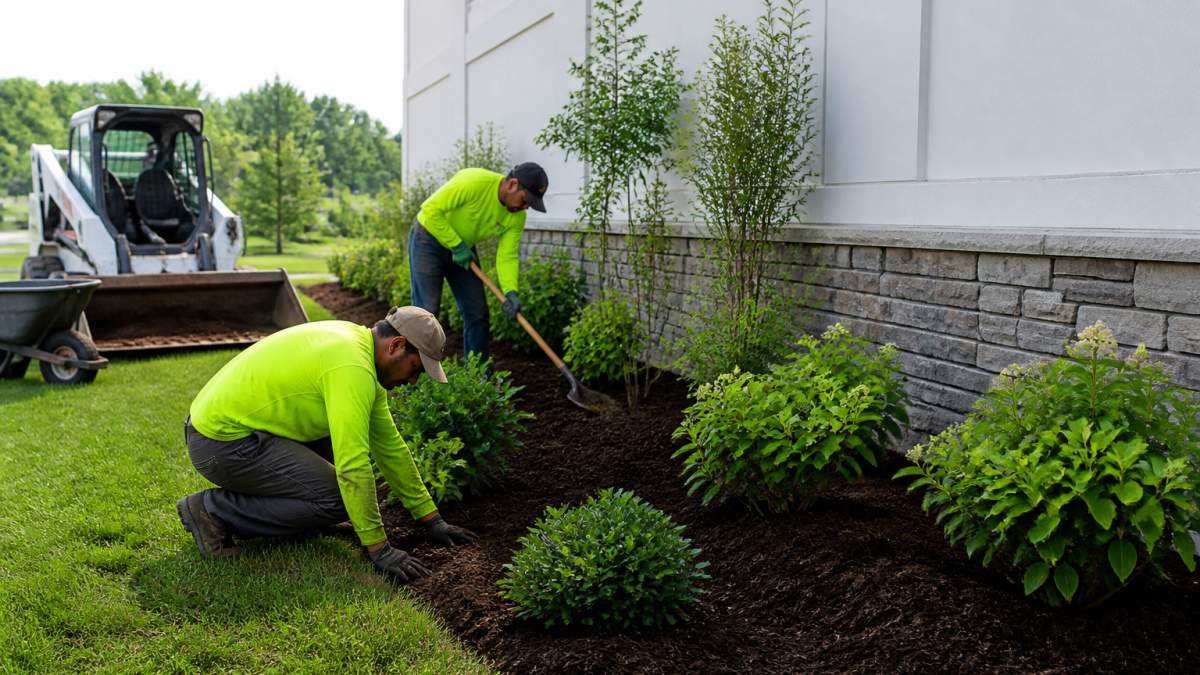
A full-service landscaping company handles multiple service categories that work together to create attractive, functional outdoor spaces.
Lawn Maintenance and Recurring Care
Lawn maintenance is the foundation of any commercial landscaping program, keeping grass healthy, preventing weeds, and maintaining the polished appearance your business needs.
Recurring lawn maintenance includes weekly or bi-weekly mowing during growing seasons, edge trimming along walkways and building perimeters, and debris removal.
Consistency matters more than most business owners realize. Sporadic care looks unprofessional and raises long-term costs because problems compound: weeds spread, bare patches expand, and disease takes hold.
Design and Installation Services
Beyond maintenance, professional landscaping services include design and installation work: new planting beds, shrubs or trees, mulched areas, or redesigned layouts that improve curb appeal or function.
Installation typically begins with a consultation where a designer assesses your property, understands your goals, and recommends improvements.
Quality installation prevents costly mistakes: improper planting depth, wrong species for your zone, or poor soil preparation all lead to plant failure and wasted investment.
Irrigation Systems and Water Management
Irrigation installation and repair is a specialized service many businesses overlook until problems appear. A properly designed system keeps plants healthy while minimizing water waste, which matters for sustainability and operating costs.
Professional landscaping companies assess your water needs, design efficient layouts, and install systems that deliver water where it's needed.
Precision irrigation management prevents overwatering, which wastes resources and damages plants, while underwatering stresses plants and hurts appearance.
Understanding Commercial Landscaping Cost and Budget Planning
Commercial landscaping pricing is one of the least transparent parts of the buying process. For a business buyer, the goal is a defensible budget and a way to compare bids apples to apples. This section covers the cost drivers that move a quote, how to structure a budget, and how to read competing proposals.
What Drives Commercial Landscaping Cost
Commercial pricing is built from labor hours, equipment, materials, disposal, and overhead, not a flat per-acre rate. The variables that move a quote most are:
- Treated acreage and edge complexity. Mowing time scales with turf area, but trimming, edging, and bed maintenance scale with linear feet of curb, building perimeter, islands, and fence line. A property with many planting beds and narrow strips costs more per acre than open turf.
- Service frequency and season length. Weekly mowing during a 28-to-32-week growing season is the common commercial baseline in most U.S. markets. Bi-weekly service lowers the invoice but usually raises corrective work later. Year-round contracts in warm climates price differently than seasonal contracts in cold climates.
- Plant and bed inventory. The number of trees, shrubs, and seasonal color rotations drives pruning, mulching, and replacement labor. Mature trees near structures add inspection and risk-management time.
- Irrigation scope. System audits, controller management, backflow testing, winterization, and spring activation are typically line items, not included in mowing.
- Site access and hours. Gated communities, loading-dock schedules, parking-lot closures, and after-hours work all add labor. Properties that require work outside business hours should expect a premium.
- Disposal and hauling. Green waste, mulch delivery, and debris hauling carry fuel and tipping fees that vary by market.
How Commercial Budgets Are Usually Structured
Most commercial buyers budget landscaping in three buckets:
- Recurring maintenance retainer. A monthly or per-visit fee covering mowing, edging, trimming, blowing, and basic bed care. This is the predictable line item.
- Seasonal and enhancement work. Spring cleanup, mulch refresh, seasonal color, aeration and overseeding, fall leaf removal, and irrigation start-up/shut-down. These are often quoted per project or as an annual allowance.
- Reserve or contingency. A set-aside for plant replacement, irrigation repairs, storm cleanup, and unexpected issues. A common planning pattern is to hold a modest percentage of the annual maintenance spend for this bucket, though the right figure depends on site age and plant inventory.
Request an annual program price that separates these three buckets, then compare providers on the same structure to see whether a lower retainer is offset by higher enhancement charges.
How to Compare Commercial Landscaping Bids
Bids are rarely apples to apples unless you force them to be. Before requesting quotes, prepare a scope sheet listing:
- Total turf acreage and bed square footage
- Number of trees and shrubs by size class
- Mowing frequency and desired cut height
- Edging and trimming standards
- Irrigation scope and who owns controller management
- Seasonal tasks and their timing
Then ask every provider to quote against that same scope and itemize the three budget buckets. A dramatically lower bid usually reflects narrower scope, less frequent service, or excluded line items rather than a better price, so ask each provider to state what is excluded.
Setting Expectations on Price Changes
Commercial contracts should state how price adjustments work, typically annual escalators tied to a published index or documented cost increases, plus separate pricing for out-of-scope work. Ask how the provider handles material cost swings, fuel surcharges, and mid-contract scope changes; clear escalation terms prevent surprise invoices and make budgeting more reliable.
What to Include in a Commercial Landscaping Contract
A commercial landscaping contract is a management tool, not just a price sheet. The strongest contracts define what good looks like in measurable terms, set response expectations, and give both parties a clear process when performance slips.
Scope, Frequency, and Standards
The contract should define scope in operational terms, not marketing language. Specify mowing height ranges by turf type, edging and trimming standards, bed weeding tolerances, mulch depth, pruning approach, and irrigation responsibilities. Include a seasonal calendar for spring cleanup, mulch refresh, aeration and overseeding, fall leaf removal, and irrigation start-up and winterization. Define what happens during weather events and who authorizes storm cleanup.
Service-Level Agreement and Measurable KPIs
A service-level agreement (SLA) converts expectations into metrics. Useful commercial KPIs include:
- Response time for routine requests. A stated window, such as next-business-day acknowledgment and a defined completion window, for non-emergency work orders.
- Response time for urgent issues. A shorter window for hazards such as a downed limb blocking a drive aisle or a broken irrigation head flooding a walkway.
- Inspection frequency. How often the account manager walks the property, and whether inspection reports are shared with the client.
- Completion standards. Pass/fail criteria for mowing, edging, bed cleanliness, and irrigation function, ideally tied to a photo-documented inspection.
- Reporting cadence. Monthly or quarterly performance summaries with issue logs and resolution status.
- Corrective action timeline. How quickly deficiencies are fixed after being reported, and what happens if they are not.
Insurance, Safety, and Compliance
Ask for certificates of insurance before work begins and at each renewal. Contracts commonly require general liability, commercial auto, and workers' compensation coverage, often with the client named as additional insured. Confirm the provider follows OSHA safety practices for equipment, chemicals, and heat exposure, that pesticide and fertilizer applications use licensed applicators, and how fertilizer and debris near drains are handled if your property has stormwater obligations.
Vendor Selection and Procurement Checklist
Before awarding a contract, evaluate providers on more than price:
- Licensing and registration required in your state or locality
- Insurance certificates with adequate limits and additional-insured status
- References from properties similar in size and use type, not just any commercial client
- Account management structure, including who your day-to-day contact is and how escalations work
- Equipment and crew capacity to service your property on schedule during peak season
- Reporting and technology, such as work-order systems, photo documentation, and client portals
Contract Terms That Protect the Business
Key terms to negotiate include the initial term and renewal structure, termination rights for cause and convenience, price escalation methodology, out-of-scope authorization, and dispute resolution. Clarify ownership of design plans or irrigation as-builts produced during the contract, and define notice periods and how scope changes are documented. A clear change-order process prevents small requests from becoming invoice disputes.
Creating a Landscape Maintenance Schedule That Works
A landscape maintenance schedule ensures consistent care and prevents problems from compounding. Align it with your region's growing season, weather patterns, and your property's needs.
Spring typically requires cleanup, mulch refreshing, and planting preparation. Summer focuses on regular mowing, weed management, and irrigation monitoring.
Professional landscaping services providers can develop a schedule customized to your property, typically weekly or bi-weekly mowing during peak growing season with adjustments for weather and plant health.
Business Landscaping Ideas for Property Appeal and Function
Strategic business landscaping ideas enhance curb appeal and how your property functions for employees and visitors.
Planting design can soften architecture, add seasonal color, and create visual interest.
Hardscaping elements like walkways, seating areas, or decorative borders add function and visual appeal. These elements require professional installation to ensure proper drainage and durability. Well-designed hardscaping also reduces maintenance needs compared to all-turf landscapes.
Sustainability and Water Efficiency
Sustainable landscaping practices reduce environmental impact while often lowering operating costs: water-efficient irrigation minimizes waste while keeping plants healthy, and native plant selection reduces maintenance and supports local ecosystems.
Many professional landscaping services now emphasize eco-friendly practices. Mulching conserves soil moisture and reduces watering, and climate-appropriate plant selection lets plants thrive without excessive water or fertilizer, aligning with corporate sustainability goals while delivering practical benefits.
Safety, Compliance, and Risk Management
Commercial properties must maintain landscapes that meet safety and liability standards. Professional landscaping services address hazards like dead branches, vegetation blocking sightlines, and tripping hazards from uneven ground.
Regular inspections catch problems before they become liabilities: proper tree maintenance prevents branch failure, and clear sightlines near parking areas and entrances reduce accident risk.
Why Reliability and Service Quality Matter
Reliability distinguishes professional landscaping services from occasional contractors. Hiring a professional landscaping services company means investing in consistency: scheduled care regardless of weather, staff changes, or other disruptions.
Service quality reflects on your business.
Lover's Lawn Services LLC brings this reliability through consistent scheduling, state-of-the-art equipment, and a commitment to precision maintenance.
Professional landscaping services transform how your commercial property looks and functions.
Frequently Asked Questions
What services do professional landscaping services for businesses typically include?
Professional landscaping services for businesses cover lawn maintenance, landscape design and installation, irrigation system setup and repair, mulching, and planting. The specific services depend on your property's needs and the service agreement you establish with your landscaping company.
How often should we schedule landscape maintenance for our business property?
Most commercial properties benefit from weekly or bi-weekly lawn maintenance during the growing season (spring through fall), with adjustments for winter. Your landscape maintenance schedule should account for your property's size, climate, and the image you want to project. A professional landscaping services provider can recommend a maintenance frequency based on your grounds and business goals.
What should a commercial landscaping contract include to protect our business?
A solid commercial landscaping contract should specify services provided, frequency of visits, pricing and payment terms, equipment and liability insurance requirements, performance standards, weather contingencies, and dispute resolution procedures. It should also outline what happens if services don't meet expectations and include clear communication protocols. This protects both your business and ensures accountability from your landscaping company.
How can we make our business landscaping more sustainable and cost-effective?
Sustainable landscaping practices include installing water-efficient irrigation systems, using native plants that require less maintenance, applying mulch to reduce watering needs, and implementing integrated pest management. These practices reduce water consumption, lower long-term maintenance costs, and improve your property's environmental impact. Ask your professional landscaping services provider about eco-friendly options that align with your business values.