 ultimate-guide
Sustainable Lawn Maintenance for Professionals
Table of Contents
- What Sustainable Lawn Maintenance Means for Professionals
- Soil Aeration and Soil Health: The Foundation
- Eco-Friendly Lawn Care Practices That Deliver Results
- Water-Efficient Lawn Maintenance Strategies
- Sustainable Lawn Care Equipment and Mowing Practices
- Grass Selection and Climate-Appropriate Varieties
- Professional Service Workflows and Client Communication
- Frequently Asked Questions
Last Updated: October 14, 2026
What Sustainable Lawn Maintenance Means for Professionals
Sustainable lawn maintenance for professionals means delivering healthy turf while reducing chemical inputs, conserving water, and building self-sustaining soil biology.
Instead of fighting nature with synthetic interventions, sustainable lawn maintenance works with soil biology, natural processes, and climate-appropriate plant selection.
The difference from conventional care is root-cause focus. A brown patch treated with fungicide returns; one addressed through aeration, organic matter amendment, and improved drainage doesn't.
Soil Aeration and Soil Health: The Foundation
Soil aeration is the single most important intervention in sustainable lawn maintenance. Compaction, near-universal in established lawns, stalls roots, fails drainage, and invites disease.
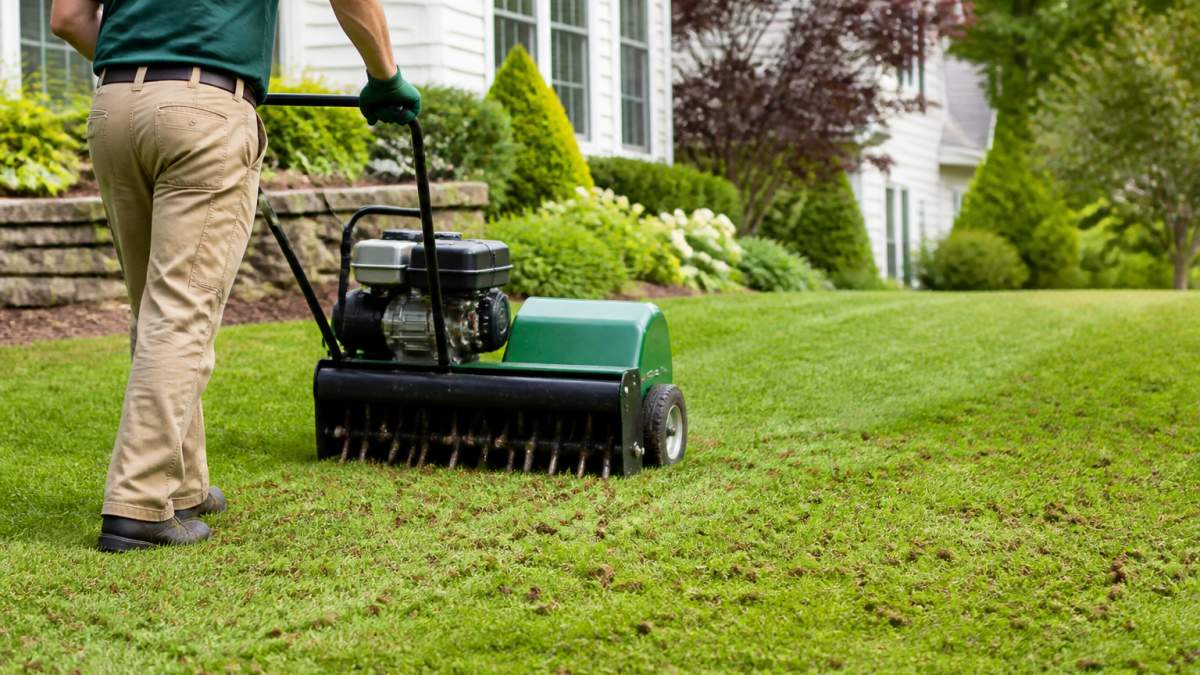
Core aeration techniques and timing
Core aeration extracts soil plugs (typically 2-3 inches deep, ¾ inch in diameter) at 2-4 inch spacing. Early fall and late spring are optimal: moderate temperatures, adequate moisture, active growth.
Spike aeration creates only short-term decompaction; core aeration is the professional standard. Most properties benefit from annual aeration; heavily trafficked areas may need twice-yearly treatment.
Testing and amending soil naturally
Soil testing reveals what's limiting growth: pH, organic matter, and nutrient levels. Most regional lawns run slightly acidic (pH 6.0-6.5), ideal for turf. Organic matter below 5% signals compaction and poor biology.
Compost is the foundation of sustainable soil health. A quarter-inch top-dressed after aeration introduces beneficial microorganisms, improves water retention, and builds soil structure.
Eco-Friendly Lawn Care Practices That Deliver Results
Eco-friendly lawn care practices reduce chemical dependency while maintaining turf quality. Most lawn problems stem from management decisions, not plant weakness, address the decisions and chemical inputs become unnecessary.
Natural weed control and pest management
Weeds rarely indicate a need for herbicide, they indicate turf density too low to occupy the space.
For isolated weeds, mechanical removal works. For larger infestations, overseed aggressively after fixing the underlying cause (compaction, poor drainage, nutrient deficiency).
Pest management follows the same logic. Chinch bugs, grubs, and other pests establish when turf stress creates vulnerability; proper mowing height, moisture, and soil health prevent damage.
Organic fertilization and compost strategies
Synthetic fertilizers spike nutrients but don't build soil. Organic fertilization, compost, slow-release organic products, targeted amendments, feeds both plant and soil ecosystem, providing immediate organic matter and gradual nutrient release over months.
Slow-release organic fertilizers release nutrients as microorganisms break them down, aligning availability with plant demand, reducing leaching, and eliminating synthetic boom-bust cycles. Most established lawns need only one to two organic applications annually versus four or more synthetic ones.
Water-Efficient Lawn Maintenance Strategies
Water conservation is both environmental responsibility and economic necessity. Sustainable lawn maintenance reduces water demand through soil improvement, plant selection, and smart irrigation timing.
Smart irrigation and deep watering techniques
Deep, infrequent watering builds deep roots that access moisture in dry periods; shallow, frequent watering creates dependent shallow roots. Most automated systems deliver shallow, frequent cycles, exactly wrong for sustainability.
Delivering 1-1.5 inches weekly in two deep applications (not daily sprinkles) trains roots deeper and cuts water use. Soil moisture sensors or manual checks prevent overwatering, and less frequent irrigation shortens leaf wetness cycles, reducing disease pressure.
Rainwater harvesting and seasonal adjustments
Rain barrels or cisterns capture roof runoff for hand-watering or supplemental irrigation during dry spells. Even modest capture (500-1,000 gallons) significantly reduces municipal water use in spring and fall.
Seasonal adjustments are critical: summer may need full application, spring and fall about 50% less, winter none. Many property managers run the same schedule year-round, matching timing and frequency to seasonal demand is an easy efficiency gain.
Sustainable Lawn Care Equipment and Mowing Practices
Equipment and mowing decisions are where sustainability claims either hold up under scrutiny or fall apart. For a professional operation, the question is not whether battery equipment is greener in the abstract, it is whether the switch pencils out across a full route, in every season, with crews who cannot afford downtime.
Electric and low-emission equipment selection
Battery-powered commercial mowers, trimmers, edgers, and blowers can now carry a full residential route, but the operating profile matters more than the spec sheet.
The real advantages for a professional operation are operational, not just environmental:
- No fuel handling. No gasoline storage, no spill risk, no fuel stabilizer, no carburetor rebuilds from ethanol-blended fuel sitting over winter.
- Lower routine maintenance. No oil changes, spark plugs, air filters, or pull-start repairs. Fewer moving parts means fewer mid-route breakdowns.
- Quieter operation. This matters on commercial and institutional properties with noise ordinances or early-morning service windows.
The trade-offs are real: higher upfront cost, battery capacity fade and replacement packs as recurring expenses, reduced cold-weather run time affecting late-fall and early-spring scheduling, and solar charging only making sense with adequate roof/ground space and sun exposure.
Mowing height, frequency, and thatch management
Mowing height is the most controllable variable in turf health, and the one most often set wrong for appearance.
The one-third rule governs frequency: never remove more than one-third of blade length per pass.
Thatch is widely misunderstood: a moderate layer (quarter to half an inch) insulates soil and slows moisture loss. Only above half an inch does it block water and nutrients and harbor pests.
Measuring fuel, emissions, and equipment KPIs
Sustainability claims are only credible if they are measured. Track a small set of equipment metrics that map directly to environmental and financial performance:
- Fuel consumed per crew-hour (or kilowatt-hours for battery equipment), the baseline for any emissions comparison.
- Equipment hours per property, reveals whether routing and equipment choices are efficient.
- Maintenance cost per operating hour, captures the hidden cost of gas equipment that spec sheets ignore.
These numbers do two things. Internally, they show where to invest next. Externally, they let you tell a client or property manager exactly how much fuel and emissions a switch avoided, far more persuasive than a general claim about being eco-friendly.
Grass Selection and Climate-Appropriate Varieties
Matching grass species and cultivars to site conditions eliminates the struggle of fighting plant nature.
Drought-tolerant cultivars reduce irrigation demand without sacrificing appearance, and native grasses suit naturalized areas with minimal input and regional biodiversity benefits.
Overseed annually in fall to maintain density and competitiveness. Dense turf crowds out weeds, resists disease, and recovers quickly from stress, consistent fall overseeding prevents most problems before they start.
Professional Service Workflows and Client Communication
Most sustainable lawn care content targets homeowners. A professional operation needs repeatable procedures crews execute identically on every property, measurable outcomes that justify the program, and documentation that holds up to property managers and regulators.
Site assessment and treatment planning
Every sustainable program starts with a site assessment, not a treatment calendar. A useful assessment captures:
- Soil test results, pH, organic matter percentage, and macronutrient levels. Organic matter below roughly 5% signals compaction and poor biology and should drive the amendment plan.
- Compaction and drainage, a simple probe or screwdriver test reveals hardpan layers and where water pools after rain.
- Turf species and density, identifies mismatched grass and bare spots that will invite weeds.
From the assessment, build a written treatment plan with a defined sequence: soil amendment, then aeration and overseeding, then fertility, then irrigation adjustments. State what will be done, when, and the expected result, that document becomes the baseline for measuring progress and answering client questions.
Crew workflows and quality control
Repeatability separates a professional service from one-off visits. A workable crew workflow:
- Pre-service check, confirm the property, review the plan, note any changes since the last visit.
- Mow and edge, set height for the season and species, follow the one-third rule, alternate mowing direction to prevent ruts and grain.
- Debris and cleanup, remove clippings where disease is present, otherwise leave them to return nutrients.
- Targeted intervention, spot-treat weeds mechanically, address any pest or disease threshold that has been crossed.
- Post-service documentation, record what was done, products applied, rates, and any observations.
Quality control is a scheduled review, not an afterthought: a supervisor spot-checks a percentage of properties weekly against the treatment plan, and documentation is audited for completeness. Track soil organic matter year over year, turf density, disease incidence, water use per property, and fertilizer per thousand square feet. A lawn needing multiple fungicide applications in year one and none in year three is a documented result, and that documentation sells the next contract.
Commercial and institutional properties
Commercial, institutional, and municipal properties add scale, access, safety, and contract requirements residential work doesn't. Campuses, parks, office parks, and sports fields often have:
- Access and scheduling constraints, service windows tied to business hours, events, or public use.
- Safety and liability exposure, pedestrian traffic, playgrounds, and athletic surfaces require different product choices and application timing.
- Contract specifications, many institutional buyers require documented IPM programs, restricted product lists, or reporting on chemical use.
For these properties, write the sustainable program into the service contract with defined reporting: a monthly or quarterly summary of treatments, products, rates, water use, and corrective actions. Institutional clients increasingly ask for this, providing it is a competitive advantage.
Client communication, cost-benefit, and compliance
Sustainable lawn maintenance typically costs more in the first year or two than a chemical-intensive program, since aeration, compost, and organic inputs carry labor and material costs.
Compliance is part of the professional obligation. Water-use restrictions, fertilizer timing rules, and pesticide notification requirements vary by state and municipality and change over time. Maintain a current reference for each service area, train crews on it, and document applications so records are available on request.
Frequently Asked Questions
What does sustainable lawn maintenance include?
Sustainable lawn maintenance combines soil health management, water conservation, organic fertilization, natural pest control, and eco-friendly equipment use. It prioritizes long-term lawn vitality and environmental responsibility over quick chemical fixes. Professionals focus on aeration, compost application, integrated pest management, efficient irrigation, and mowing practices that reduce carbon emissions while maintaining healthy turf density and appearance.
How can lawn care professionals reduce water use?
Professionals reduce water consumption through smart irrigation systems that adjust to rainfall and seasonal needs, deep watering practices that encourage root development, mulching to retain soil moisture, and selecting drought-tolerant grass varieties suited to local climate. Rainwater harvesting systems and soil amendments that improve water retention further cut overall water demand while maintaining lawn health and appearance.
What are the best organic alternatives to synthetic lawn fertilizers?
Top organic alternatives include compost applications, which build soil organic matter and release nutrients slowly; natural fertilizers like bone meal, blood meal, and kelp extracts; grass clippings left on the lawn (grasscycling); and legume cover crops that fix nitrogen naturally. Soil testing guides precise application rates, ensuring adequate nutrition without excess runoff or environmental harm. These methods improve soil structure and microbial activity over time.
Is sustainable lawn care more expensive than conventional lawn care?
Initial costs may be higher due to specialized equipment, soil testing, and organic inputs, but long-term expenses often decrease. Healthier soil requires less fertilizer and fewer pest treatments; deep watering and proper mowing reduce emergency repairs. Making sustainable practices a solid investment.
How often should professionals mow a lawn sustainably?
Sustainable mowing typically follows the one-third rule: cut no more than one-third of the grass blade height per mowing. Frequency depends on growth rate and season, usually weekly in spring and early fall, less often in summer dormancy. Leaving grass clippings on the lawn (grasscycling) returns nutrients and reduces waste. Proper mowing height (2.5 to 3.5 inches for cool-season grasses) strengthens root systems and reduces stress.
How can professionals improve soil health naturally?
Improve soil health through core aeration to reduce compaction and enhance root development, regular compost and organic matter application to increase soil structure and microbial life, soil testing to guide amendments, and cover cropping in off-season areas. These practices build water retention, drainage, and nutrient availability naturally, reducing dependence on synthetic inputs and creating resilient turf that handles stress better.
What lawn care equipment has the lowest environmental impact?
Electric mowers, edgers, and leaf blowers produce zero direct emissions and run quieter than fuel-powered alternatives. Solar-powered equipment is emerging for certain applications. Battery-powered tools reduce fuel consumption and maintenance waste. Manual tools like reel mowers require no power but suit smaller properties. Professionals should evaluate equipment lifespan, battery recycling programs, and total lifecycle emissions when selecting tools.
How can you control weeds without relying on chemical herbicides?
Integrated pest management combines dense, healthy turf (which outcompetes weeds), proper mowing height, hand-pulling for isolated weeds, mulching to suppress growth, and targeted organic herbicides derived from natural compounds like citric acid or clove oil. Soil health improvements and appropriate grass selection reduce weed pressure naturally. Regular monitoring and early intervention prevent infestations and reduce the need for any treatments.