 how-to
Why Does My Lawn Have Brown Patches: A Diagnosis Guide
Table of Contents
- How to Identify Brown Patches on Your Lawn
- What Causes Brown Spots in My Lawn: The Main Culprits
- Step-by-Step Inspection Checklist: Diagnosing Your Brown Patches
- Brown Patch Lawn Disease Treatment: Immediate Action Steps
- Best Fungicide for Brown Patch: When and How to Apply
- How to Repair Dead Patches in Grass: Recovery and Reseeding
- Prevention: Avoiding Brown Patches Year-Round
- Frequently Asked Questions
Last Updated: October 12, 2026
How to Identify Brown Patches on Your Lawn
If you're wondering why does my lawn have brown patches, the answer is that brown patches signal several problems. At Lover's Lawn Services LLC, we help homeowners diagnose the root cause so they can fix it properly.
What healthy grass looks like versus affected turf
Healthy grass stands upright, evenly green, with firm blades and no bare spots. Affected turf turns yellow-brown or tan, feels brittle, pulls up easily, and forms distinct circular or irregular patches.
Common patterns and patch edges
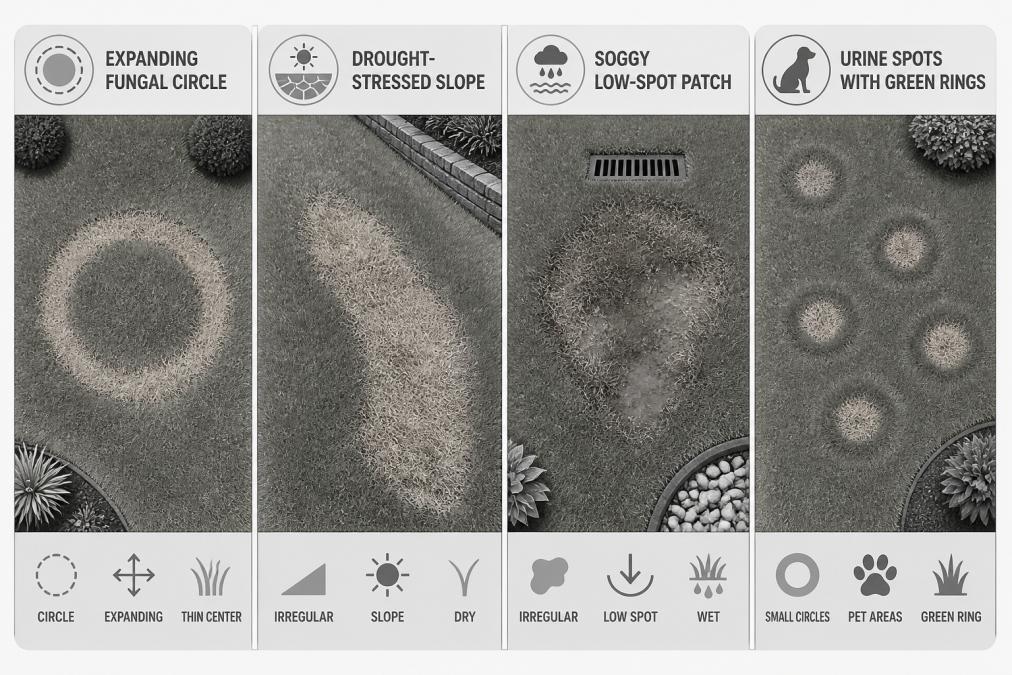
Brown patches typically appear in circles or rings with sharply defined edges, sometimes with a dark ring around lighter dead grass. The pattern reveals the cause: fungal disease spreads in circles, drought damage is scattered, and pet urine creates circular spots.
What Causes Brown Spots in My Lawn: The Main Culprits
Brown patch fungal disease and Rhizoctonia solani
The fungus attacks the blade base near the crown, so affected blades pull up easily with a gentle tug.
Drought stress and underwatering
Drought damage works top down: grass closes its stomata, photosynthesis slows, and blades lose color from the tip backward.
Poor drainage and compacted soil
Compaction and poor drainage kill grass by suffocation, not thirst.
The signature is a patch that stays soggy a day or more after rain while the rest of the lawn drains normally.
Pet urine, thatch, and chemical damage
Pet urine kills grass through a nitrogen and salt burn.
Thatch is the spongy layer of dead stems, roots, and organic matter between the soil surface and the green blades.
Chemical damage comes from three sources: fertilizer spills or overlaps, herbicide drift or misapplication, and de-icing salt along walkways.
A quick way to narrow it down
Step-by-Step Inspection Checklist: Diagnosing Your Brown Patches
This checklist tells you what to look at, in what order, and what each result means.
Step 1: Map the patch pattern
Stand back and look at the whole lawn. Patch shape is the most useful clue.
- Circular or irregular patches that expand outward over days = fungal disease
- Scattered browning that follows sun exposure, slopes, or pavement edges = drought stress
- Soggy patches in low spots, near downspouts, or at the bottom of slopes = poor drainage
- Small spots (6-12 inches) scattered across the lawn with dark green rings = pet urine
- Streaks, straight lines, or spreader-shaped patterns = chemical damage
Step 2: Examine the patch edge and blades up close
Kneel down and examine where brown meets green.
- Sharp, defined edge with a dark smoky ring (visible in morning dew) = brown patch fungus
- Fuzzy, gradual transition from green to brown = drought or general stress
- Green ring surrounding a dead center = pet urine
- Crisp line between healthy and dead grass = chemical burn or salt
Now pull a few blades from the edge of the patch and look at them.
- Blades pull up easily with a gentle tug, base is rotted = fungal disease
- Blades are crispy and snap when bent = drought stress
- Blades are mushy or slimy at the base = drainage problem or Pythium
- Blades are cupped, twisted, or bleached = herbicide injury
Step 3: Test soil moisture at root depth
Surface moisture lies.
- Probe slides in easily in both spots = soil moisture is fine; cause is likely disease or chemical
- Probe resists in the patch but slides in elsewhere = compaction or dry soil
- Probe slides in easily in the patch but resists elsewhere = overwatering or poor drainage in that spot
If the probe comes up wet and the soil smells sour or sulfurous, that's a strong sign of anaerobic conditions from poor drainage.
Step 4: Check the roots and crown
Dig up a small plug (about 3 inches square) from the patch edge with a trowel. Look at the roots.
- Roots are brown, short, and rotted = fungal disease or root rot
- Roots are white and firm but the blades are dead = drought or heat stress
- Roots are shallow and matted in the thatch layer = thatch buildup
- Roots are black and smell foul = severe drainage problem
Step 5: Run an irrigation coverage test
This is the step most homeowners skip, and it's often the answer.
- Cans inside the patch collect much more water than cans elsewhere = overwatering or a misaimed head
- Cans inside the patch collect much less = a clogged or misaligned head is starving that zone
- All cans collect similar amounts = irrigation is even; look elsewhere for the cause
Aim for roughly 1 to 1.5 inches of water per week total, including rainfall, delivered in one or two deep sessions rather than daily light sprinkles (Efficient Lawn Irrigation in the Intermountain West).
Step 6: Review the last three weeks
Weather and lawn-care history explain a lot of brown patches.
- Warm nights (above 68°F), high humidity, and heavy dew = fungal disease favored
- Hot, dry stretch with no irrigation = drought stress
- Heavy rain followed by heat = fungal disease or drainage problem
- Recent fertilizer, herbicide, or salt application = chemical damage
- Recent mowing at a very low height = scalping stress that opens the door to disease
Putting the results together
If two or more checks point the same direction, you've found your cause.
Brown Patch Lawn Disease Treatment: Immediate Action Steps
Once you've identified the problem, take action. Quick response prevents the damage from spreading.
Adjusting watering practices and irrigation coverage
The most important step is fixing your watering schedule. Water deeply but less frequently to encourage deep roots and reduce surface moisture. Water early in the morning, before 8 a.m., so the lawn dries during the day; avoid evening watering.
- Water 1 to 1.5 inches per week total (including rain)
- Water once or twice per week, not daily
- Let the soil dry slightly between waterings
- Check your irrigation coverage for dry spots or overwatered areas
If you have poor drainage, reduce watering frequency even more. Let the soil dry out between waterings.
Improving air circulation and mowing practices
Better air circulation dries the grass and reduces fungal disease, so trim back trees and shrubs that shade the lawn. Mow at the correct height for your grass type, since cutting too short stresses grass and encourages disease.
- Cool-season grasses: mow at 2.5 to 3.5 inches
- Warm-season grasses: mow at 1.5 to 2.5 inches
- Never remove more than one-third of the blade length in one mowing
- Keep mower blades sharp to avoid tearing grass
Remove thatch if it's thicker than half an inch. Thatch removal improves water penetration and air flow.
Best Fungicide for Brown Patch: When and How to Apply
Fungicide is a tool, not a cure. It only works if you've also fixed the underlying moisture problem; without addressing watering and drainage, the disease will return.
Identifying when fungicide is necessary
Fungicide makes sense in these situations:
- You've confirmed fungal disease through the inspection checklist
- You've already improved watering and drainage practices
- The disease is actively spreading despite your changes
- You have a cool-season grass that's being hit hard in late spring or early fall
Fungicide doesn't help with drought, poor drainage, pet urine, or chemical damage. Don't waste money on it for those problems.
Application timing and eco-friendly options
Apply fungicide when conditions favor the disease: warm weather, high humidity, and wet grass. Follow the label directions exactly.
Eco-friendly options include sulfur-based fungicides and neem oil. These are gentler on beneficial soil organisms. Synthetic fungicides work faster but stay in the environment longer.
The Lover's Lawn Services LLC team uses state-of-the-art equipment to apply treatments precisely where needed, with eco-friendly practices that protect your lawn and the environment.
How to Repair Dead Patches in Grass: Recovery and Reseeding
Dead grass won't come back on its own, you need to reseed, and timing and preparation matter.
Realistic recovery timelines by grass type
Recovery depends on your grass type and the damage severity.
| Grass Type | Time to Recovery | Best Reseeding Window |
|---|---|---|
| Cool-season grasses | 4-8 weeks | Fall or early spring |
| Warm-season grasses | 6-12 weeks | Late spring or summer |
| Severely damaged areas | 8-12 weeks | Next appropriate season |
Cool-season grasses (fescue, bluegrass, ryegrass) recover faster in fall and spring. Warm-season grasses (Bermuda, zoysia) recover faster in late spring and summer.
Reseeding and soil preparation steps
Wait until the area is completely dry before reseeding; wet soil leads to poor germination.
- Remove all dead grass and debris from the patch
- Loosen the soil with a rake or small tiller
- Add a thin layer of compost or topsoil
- Spread seed evenly across the area
- Keep the area moist (not soggy) for 2-3 weeks
- Avoid walking on the area until grass is established
Once new grass is growing, treat it like the rest of your lawn. Don't overwater or mow too short. Let it strengthen before full use.
Prevention: Avoiding Brown Patches Year-Round
The best approach is stopping brown patches before they start. Prevention is easier than recovery.
Seasonal watering schedules and mowing height
Create a watering schedule that matches your climate and grass type. Late spring and summer need careful attention because fungal disease thrives, water deeply but less frequently and let the grass dry between waterings. Fall and winter need less water as cool-season grasses slow their growth.
Thatch management and soil aeration
Thatch builds up over time; remove it when it exceeds half an inch, with spring or fall the best times to dethatch.
Brown patches don't have to ruin your lawn. Identify the cause, fix the underlying problem, and your grass will recover. Our eco-friendly practices and state-of-the-art equipment ensure your lawn stays healthy year-round. Learn more about proper lawn care practices from university extension services to understand your regional growing conditions.
Frequently Asked Questions
How do I tell if brown patches are caused by fungus or drought?
Fungal disease typically shows yellow-brown grass blades with soft, mushy texture near patch edges, and spreads quickly in heat and humidity. Drought stress produces brittle, dry grass that browns uniformly across the lawn and develops slowly over weeks. Check soil moisture: fungal brown patch occurs with excessive moisture or prolonged wetness, while drought happens during underwatering. Fungal patches often have a distinctive ring or halo pattern; drought damage is more scattered.
What is the best fungicide for brown patch treatment?
Certain fungicides can be effective for brown patch fungal disease. Eco-friendly options include sulfur-based treatments and biological fungicides. Timing matters more than product choice: treat before the disease spreads quickly through your turfgrass. Always follow label directions and consider professional application for best results.
Will brown patches of grass grow back on their own?
This depends on the cause. If brown patches result from temporary drought or poor watering practices, grass often recovers within 2-3 weeks once soil moisture improves and air circulation increases. Fungal brown patch damage typically requires treatment to stop spread; without intervention, affected turf dies and requires reseeding. Cool-season grasses recover faster than warm-season varieties. Dead or severely damaged areas rarely fill in naturally and usually need soil preparation and reseeding for full lawn recovery.
Should I water my lawn if the grass is already brown?
Watering depends on the cause. If brown patches result from drought stress or underwatering, increase irrigation immediately and adjust your watering schedule to maintain consistent soil moisture without overwatering. However, if fungal disease is present, reduce watering frequency and water only in early morning to minimize prolonged wetness that encourages fungal growth. Poor drainage compounds the problem; if water pools after rain, focus on drainage improvement rather than more watering. Assess soil moisture first before adjusting irrigation coverage.