 Ultimate guide
The Homeowner's Guide to Sustainable Lawn Care Practices
Last Updated: November 12, 2026
Quick Summary
Sustainable lawn care means maintaining grass with methods that cut synthetic fertilizer, pesticide, and water use while keeping the lawn healthy, not neglecting it. Mow high at 3 to 3.5 inches, water about one inch weekly in early morning, leave clippings, and follow a season-by-season plan of soil testing, fall aeration, and organic feeding.
- Set the mower blade to about 3 to 3.5 inches and never cut more than one-third of blade height.
- Water early in the morning, roughly one inch per week including rainfall, in one or two long soakings.
- Follow a seasonal plan: soil test and overseed in spring, aerate and apply organic fertilizer in fall.
- Choose slow-release organic nitrogen from compost, feather meal, or alfalfa and apply at the label rate.
- A clover lawn fixes its own nitrogen and needs less fertilizer once established, but keep flowers away from barefoot zones.
Table of Contents
- What Sustainable Lawn Care Practices Actually Change
- Mowing and Watering Rules That Conserve Resources
- DIY Organic Lawn Care: A Season-by-Season Plan
- Choosing an Organic Lawn Fertilizer That Works
- Weed and Pest Control Without the Chemical Cycle
- Why a Clover Lawn Belongs in a Sustainable Yard
- Your Sustainable Lawn Care Practices PDF Checklist
- Booking a Hands-Off Sustainable Lawn Care Plan
- Frequently Asked Questions
What Sustainable Lawn Care Practices Actually Change
Sustainable lawn care practices are maintenance methods that keep grass healthy while reducing synthetic fertilizer, pesticide, and water use, and the first thing they change is how you read your own yard. According to Gitnux's lawn care industry statistics report, some households mow about 25 times a year, which means every small habit repeats two dozen times. Research indexed by PubMed Central on residential yard-care practices shows yard care varies widely by neighborhood, soil, and rainfall, so a copied schedule rarely fits.
Here is what most guides get wrong: sustainable care is not lawn neglect. The University of Maryland Extension's organic lawn care guidance describes the goal as cutting synthetic fertilizer and pesticide use, not abandoning mowing, watering, or feeding. If you want the full side-by-side, see our comparison of eco-friendly and chemical lawn care.
Mowing and Watering Rules That Conserve Resources
Mow high and water deep but infrequently, and your lawn will need less of both. Set the blade to about 3 to 3.5 inches, never cut more than one-third of the blade height in a single pass, and leave the clippings on the lawn to return nitrogen. Water early in the morning, roughly one inch per week including rainfall, delivered in one or two long soakings rather than daily sprinkles.
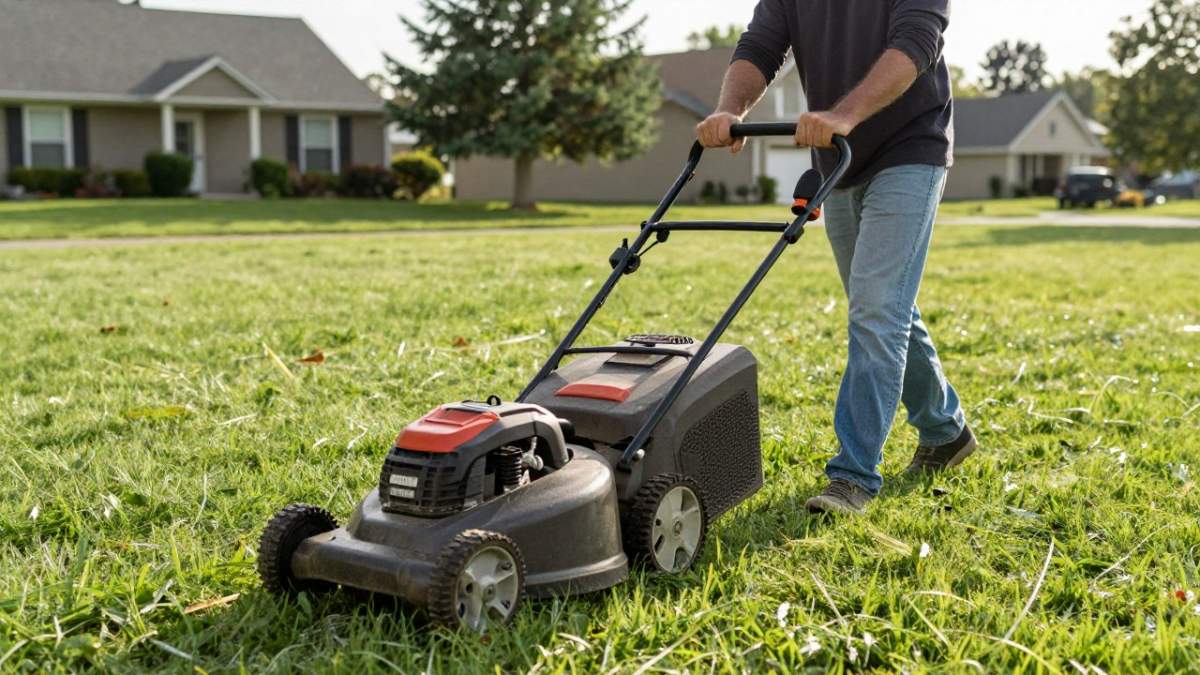
A common mistake is scalping the lawn in spring to "wake it up." That stresses roots right when weeds are ready to move in. Sharpen the blade monthly during the growing season; a dull blade tears grass and invites disease.
DIY Organic Lawn Care: A Season-by-Season Plan
DIY organic lawn care follows the seasons rather than a product label. Spring: sharpen equipment, test soil, overseed thin spots, and top-dress with compost. Summer: mow high, water deeply, and spot-treat weeds by hand. Fall: aerate, overseed, and apply an organic fertilizer. Winter: stay off wet turf and plan next year's soil improvements.
If aeration and overseeding feel like too much equipment to rent and haul, our aeration and overseeding service covers exactly that fall step.
| Season | Core Task | Frequency | Why It Matters |
|---|---|---|---|
| Spring | Soil test, overseed, compost top-dress | Once | Fixes the foundation before growth surges |
| Summer | Mow high, deep watering, hand-weed | Weekly mow, 1-2 waterings | Protects roots in heat |
| Fall | Aerate, overseed, organic feed | Once | Best window for root establishment |
| Winter | Stay off wet turf, plan | As needed | Prevents compaction damage |
Choosing an Organic Lawn Fertilizer That Works
The best organic lawn fertilizer matches its nitrogen release to your soil test, not to the biggest number on the bag. Look for slow-release nitrogen from compost, feather meal, or alfalfa, apply at the label rate in early fall and again in late spring, and water it in. A discrete choice study on sustainable lawn care preferences found eco-friendly attributes genuinely influence what buyers will pay for, so read labels rather than marketing claims.
Watch out: piling on extra organic fertilizer "because it's natural" still burns grass and wastes money. More is not safer.
Weed and Pest Control Without the Chemical Cycle
Weed and pest control without chemicals starts with density: a thick, tall lawn crowds out crabgrass and dandelions before they establish. Pull weeds after rain when soil is soft, spread corn gluten meal as a pre-emergent in early spring, and identify insects before treating anything. Our guide on identifying lawn pests naturally walks through what you are actually looking at, and our organic weed control how-to covers step-by-step removal.
The chemical cycle is real: broad-spectrum sprays knock back beneficial insects along with pests, and the rebound is often worse. Spot treatment beats blanket treatment almost every time.
Why a Clover Lawn Belongs in a Sustainable Yard
A clover lawn fixes its own nitrogen, stays green through dry spells, and feeds pollinators, which is why it belongs in a sustainable yard rather than beside it. Microclover mixes well with tall fescue and needs less fertilizer once established. According to Gitnux's industry data, 58% of millennials favor eco-friendly lawn care practices, and clover is one of the simplest ways to deliver it.
One honest limitation: clover flowers attract bees, so keep it away from barefoot play zones. In practice, most homeowners blend it into the back half of the yard.
Your Sustainable Lawn Care Practices PDF Checklist
Use this sustainable lawn care practices PDF checklist as a printable season tracker you can stick on the fridge:
- Soil test completed and filed
- Mower blade sharpened and set to 3 to 3.5 inches
- Watering schedule set for early morning, one inch weekly
- Fall aeration and overseeding booked
- Organic fertilizer applied at label rate
- Weeds hand-pulled after rain
- Clover or pollinator patch planned
If you would rather hand the whole list to someone, our seasonal lawn care plans turn it into a scheduled service.
Booking a Hands-Off Sustainable Lawn Care Plan
The hardest part of sustainable lawn care is consistency, not knowledge. Twenty-five mowings a year, sharpened blades, timed feedings, and fall aeration all have to happen on schedule, which is exactly where busy homeowners fall behind. That is what Lover's Lawn Services LLC is built around: eco-friendly practices, state-of-the-art equipment, and a calm, intentional approach that keeps a yard balanced year-round. We back it with a 100% satisfaction guarantee and a 3-day refund policy, and more than 500 local homes have trusted us with their lawns. Get started with Lover's Lawn Services LLC and hand off the checklist for good.
Sustainable lawn care rewards the homeowner who plans a season ahead, and it punishes the one who reacts week to week. Lover's Lawn Services LLC brings eco-friendly methods, precise equipment, and dependable scheduling to every property, with a 100% satisfaction guarantee and a 3-day refund policy behind the work. Get started with Lover's Lawn Services LLC and let a healthier, greener yard run on a plan instead of a reminder.
Frequently Asked Questions
What is the 1/3 rule in lawn care?
The 1/3 rule means never cutting more than one-third of the grass blade height in a single mowing. If your lawn is 3 inches tall, set the mower to 2 inches. Cutting more stresses the grass, thins the canopy, and lets weeds move in. Following it also lets you leave clippings on the lawn, which return nitrogen to the soil and reduce how much organic lawn fertilizer you need. It is one of the simplest sustainable lawn care practices to adopt.
What are three examples of sustainable lawn care practices?
Three practical examples: mow high and leave the clippings, water deeply once a week instead of lightly every day, and fertilize with organic lawn fertilizer in fall rather than synthetic products in spring. Each one reduces inputs while keeping the lawn dense. A clover lawn or overseeding with clover is a fourth option that adds nitrogen naturally. All four appear in most sustainable lawn care practices PDF checklists because they are low-cost and repeatable.
How often should I water my lawn to conserve water?
Most cool-season lawns need about 1 inch of water per week, delivered in one or two deep sessions rather than daily sprinkling. Deep watering pushes roots downward, so the grass handles dry spells better. Water early in the morning to reduce evaporation. Some households mow about 25 times a year, and watering frequency should shift with the season rather than stay fixed.
Are clover lawns more sustainable than grass lawns?
A clover lawn usually needs less nitrogen fertilizer because clover fixes nitrogen from the air, and it stays green through dry periods with less watering. It also tolerates lower mowing. The trade-off is appearance: clover does not give the uniform carpet look some homeowners want. Many sustainable lawn care practices mix clover into an existing lawn rather than replacing it entirely, which keeps the lawn dense and cuts fertilizer use.
What is the most environmentally friendly way to fertilize a lawn?
Apply organic lawn fertilizer in early fall, when grass roots are growing and can take up nutrients before winter. Compost topdressing and slow-release organic products feed soil biology rather than just the grass blades. Organic lawn care generally focuses on reducing synthetic fertilizer and pesticide use, not on eliminating basic care. Soil testing first tells you what the lawn actually needs, so you avoid over-applying.
How can I make my lawn more sustainable without hiring a service?
Start with three changes: set the mower higher, water deeply once a week, and switch to an organic lawn fertilizer applied in fall. Add clover seed to thin patches and leave clippings on the lawn. Healthy soil plus good mowing, watering, and fertilizing practices form the foundation of sustainable care. A season-by-season plan keeps the work manageable, and a sustainable lawn care practices PDF checklist helps you track what was done and when.