 How-to
How Can You Identify Lawn Pests Naturally?
Last Updated: November 3, 2026
Quick Summary
You can identify lawn pests naturally by walking your whole yard in a grid and inspecting grass blades, thatch, and soil before treating anything. Match what you find to the four main turf pest groups, root feeders, surface caterpillars, billbugs, and chinch bugs, using size, location, and season, not a photo alone.
- A full inspection walk takes about fifteen minutes and should cover the whole yard, not just bad spots.
- White grubs are C-shaped larvae found in the top 1 to 3 inches of soil, most often late summer through fall.
- Chinch bugs are about 1/5 inch long and can be floated to the surface with the flood method.
- Cut a square about a foot wide and count grubs per square foot, sampling healthy turf for comparison.
- Straight-edged damage often points to something other than pests, such as fungal disease or compaction.
Table of Contents
- Start With a Lawn Pest Inspection Walk
- Types of Lawn Bugs Pictures: Match What You See
- Bugs That Eat Grass Roots: Underground Clues
- How to Get Rid of Lawn Bugs Naturally
- Beneficial Insects in the Lawn: Know the Helpers
- Lookalike Damage: When It Is Not an Insect
- Book a Natural Lawn Pest Inspection
- Frequently Asked Questions
Start With a Lawn Pest Inspection Walk
You can identify lawn pests naturally by walking your yard and looking closely before you treat anything, that walk is how you identify lawn pests without chemicals. The EPA's integrated pest management guidance puts monitoring and correct identification first.
Here is how to run that walk. It takes about fifteen minutes.
- Walk the whole yard in a grid, not just the bad spots.
- Note where the damage starts and stops. Sharp, straight edges often mean something other than bugs.
- Look at the grass blades first, then the soil.
- Write down what you see before you touch anything.
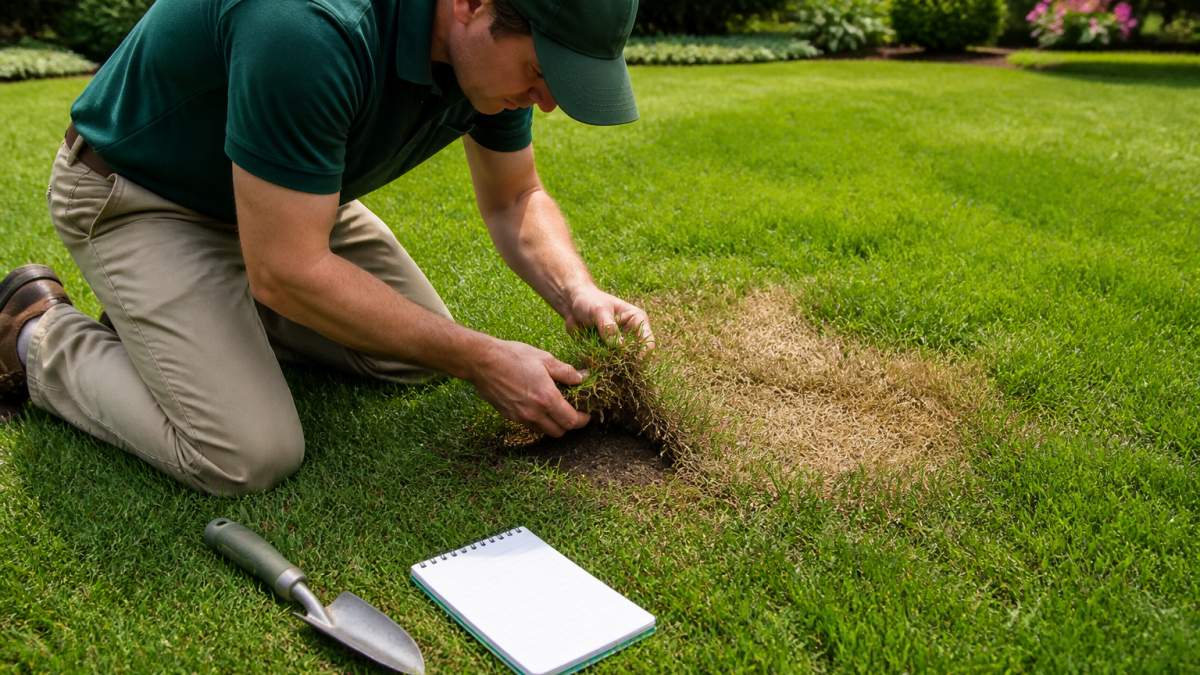
Types of Lawn Bugs Pictures: Match What You See
Comparing what you find to types of lawn bugs pictures can help narrow things down, but the photo only helps if you know what to measure and where to look. Most turf pests fall into four working groups: root feeders, surface caterpillars, billbugs, and chinch bugs. Each group has a distinct body shape, a distinct place it hides, and a distinct season when it is large enough to find.
Use this table as your field key. Sizes are approximate ranges you can check against a ruler or a hand lens.
- White grubs (root feeders): fat, white, C-shaped larvae, roughly 1/4 to 1 inch long, with a tan head and three pairs of legs near the head. You find them curled in the top 1 to 3 inches of soil and thatch, most often late summer through fall. The count per square foot is what matters.
- Sod webworms (surface caterpillars): small caterpillars, usually 1/2 to 3/4 inch when mature, that curl into a C when disturbed and often thrash. They feed at night on blades and hide in the thatch by day, so look for them at dusk or flush them with a soapy-water drench. Damage shows as notched or scalped blades in irregular patches, typically in late spring and again in late summer.
- Chinch bugs: tiny, fast-moving insects, about 1/5 inch long, black with white wings folded in an X pattern on the adults; nymphs are smaller and reddish. They cluster in thatch and at the base of blades, and the flood method, pushing a bottomless can into the turf and filling it with water, floats them to the surface. Damage shows as yellowing that turns brown in sunny, dry spots, usually in midsummer.
- Billbugs: dark, hard snout beetles, about 1/4 to 1/3 inch long, with a curved beak; the legless white larvae feed inside stems and crowns, so the turf pulls up with a hollowed stem. Look for them in late spring through summer, and split a suspect stem to confirm the larva is inside rather than in the soil.
A hand lens helps, and so does good light, overcast or shaded light hides the color patterns on chinch bugs and the head capsule on grubs. Photograph the insect next to a coin or ruler so the size is recorded, and note whether it was on the blade, in the thatch, or in the soil. That location is often more diagnostic than the photo itself.
Watch out: a photo match alone is not confirmation. Two caterpillars that look alike can have different feeding habits and different natural controls, so pair the picture with the location, the season, and the damage pattern before you act. If you cannot match what you see to a clear photo, do not guess, treating the wrong pest wastes money and can harm the insects you want to keep.
Use this field key to match what you find to the four main turf pest groups.
| Pest | Size | Where to look | When to find it |
|---|---|---|---|
| White grubs | 1/4 to 1 inch | Top 1 to 3 inches of soil and thatch | Late summer through fall |
| Sod webworms | 1/2 to 3/4 inch | Thatch by day, blades at night | Late spring and late summer |
| Chinch bugs | About 1/5 inch | Thatch and base of blades | Midsummer |
| Billbugs | 1/4 to 1/3 inch | Inside stems and crowns | Late spring through summer |
Bugs That Eat Grass Roots: Underground Clues
Root-feeding insects leave clues above ground, but the proof is underground, and the proof only counts if you sample the same way each time. A single dug square tells you almost nothing; a repeatable sample tells you whether a suspected infestation is significant or just background noise.
Start with the above-ground clues. Turf that pulls up easily, like a loose carpet, is a classic tug test result and a strong sign of grubs. Spongy ground underfoot, birds or raccoons tearing at the lawn at night, and patches that wilt first on hot afternoons and then stay brown all point the same direction. None of those clues confirms a pest on its own.
Then sample like this:
- Pick sample sites, not just the bad spot. Choose several locations across the damaged area and at least one healthy area for comparison. A common pattern is to take a handful of samples per zone rather than one.
- Cut a square about a foot wide with a trowel or a golf-course-style cup cutter. Cut through the thatch and about 2 to 3 inches of soil so the roots come up with the turf.
- Fold the turf back and count the grubs in the soil and thatch layer. Count every grub you see, and note the size, small grubs and large grubs point to different life stages and different timing.
- Record the count per square foot, the date, and the location. Repeat the same cut in the same zone on later visits so you can compare counts over time instead of guessing from memory.
- Replace the turf and water it. The sample should heal if the roots were healthy.
What the count means depends on the grass and the grub species. A few grubs per square foot are normal and usually not worth treating; a crowd of them under one square foot, with roots chewed short, points to a real problem.
Watch out: sampling only the worst-looking patch inflates the count and can push you toward a treatment the rest of the lawn does not need. Sample the healthy turf too, and write the numbers down before you decide.
If you suspect grubs, our grub control service is available, but the sample count is what tells you whether that step is warranted at all.
How to Get Rid of Lawn Bugs Naturally
Getting rid of lawn bugs naturally starts with the least invasive step that works. The EPA's IPM principles say the same thing: identify first, then act, and use the mildest effective method.
Work through this order:
- Fix the lawn first. Water deeply and less often. Aerate compacted soil. Mow high.
- Encourage natural enemies. Birds, ground beetles, and parasitic wasps do a lot of the work for free.
- Hand-remove what you can. A bucket of soapy water handles small caterpillar patches.
- Spot-treat, not blanket-treat. Target only the damaged area.
- Watch out: never spray a flowering lawn in the middle of the day. Bees and other pollinators are active then, and a broad spray can wipe out the helpers you need.
Give each step a week or two before escalating. Most mild infestations settle down on their own.
Beneficial Insects in the Lawn: Know the Helpers
Many insects in your yard are on your side. Ground beetles eat grubs and caterpillars. Lady beetles and lacewings feed on soft-bodied pests. Parasitic wasps lay eggs inside caterpillars and stop them from feeding.
Before you treat anything, ask one question: is this insect eating my grass, or eating the insect that eats my grass? If you cannot tell, leave it alone. Keep a few undisturbed corners of the yard, and skip broad-spectrum sprays. A lawn with a healthy web of natural enemies needs less help from you.
Lookalike Damage: When It Is Not an Insect
Not every brown patch is a bug problem. Fungal disease, drought stress, soil compaction, and dog urine all mimic insect damage. Straight-edged damage often points to something other than pests.
Watch for these tells:
- Fungal disease: irregular rings or spots that spread in wet weather.
- Drought stress: browning on high, sunny spots that recovers after watering.
- Compaction: thin, hard ground where water runs off.
- Weeds: crabgrass crowding out turf looks like thinning grass from a distance.
If watering does not fix it, our brown patch diagnosis guide walks through the lookalikes step by step. When the cause turns out to be fungal, our fungus control service handles it. And if weeds are the real issue, crabgrass control is the right fix.
Book a Natural Lawn Pest Inspection
You have done the walk, checked the blades, and dug into the soil. If the damage is spreading or you cannot pin down the cause, it is time to bring in a trained eye. We inspect the turf and work toward an eco-friendly plan.
Our team has served 500+ local homes and holds a 4.9/5 Google rating. Our service is backed by a 100% satisfaction guarantee with a 3-day refund policy. Have questions before you book? Our frequently asked questions page covers what to expect.
Get started with Lover's Lawn Services LLC for a lawn that looks healthy year-round.
Frequently Asked Questions
How do you get rid of lawn pests naturally?
Start by confirming the pest with a simple inspection: part the grass, check the thatch, and use a flotation test for chinch bugs or a soil sample for grubs. Once identified, remove excess thatch, water deeply but less often, and apply beneficial nematodes or insecticidal soap where appropriate. If damage is widespread, a professional natural lawn pest inspection can confirm the cause before you treat.
What is the hardest pest to get rid of?
Chinch bugs are often the hardest to control because they are tiny, fast, and feed on grass blades near the soil line, so damage appears before you notice the insects. They also thrive in hot, dry conditions that weaken turf. The flood method survey, pouring water over a small area and watching for bugs to surface, is a reliable natural way to confirm chinch bugs. Grubs can also be stubborn because they live underground and go unnoticed until turf lifts easily.
How can I identify bugs in my lawn?
Use a three-step routine: first, walk the lawn and note irregular brown or yellow patches; second, part the grass and examine blades and thatch for chewed edges, webs, or tiny insects; third, sample the soil by digging a small square of turf and counting grubs. For chinch bugs, press a coffee can open-side down into the soil, fill with water, and watch for bugs floating after 10 minutes. Compare what you find with a trusted types of lawn bugs pictures guide to confirm the species before treating.
Are all insects in the lawn harmful to grass?
No. Many insects are beneficial or neutral. Ground beetles, ladybugs, and parasitic wasps prey on pest insects, while earthworms improve soil structure. Before applying any control, identify whether the insect is a pest, a predator, or a pollinator. Protecting beneficial insects in the lawn helps keep pest populations in check naturally and supports pollinators.
A brown patch that keeps coming back is frustrating, and guessing at treatments usually makes it worse. Our team identifies the cause first, then treats it with eco-friendly methods that protect your lawn and the insects that help it. Book an inspection and we will confirm what is actually damaging your turf, back the work with our 100% satisfaction guarantee, and put a clear plan in place.