 How-to
Lawn Maintenance Scheduling: The Greener Yard Plan
Last Updated: November 13, 2026
Quick Summary
Effective lawn maintenance scheduling means timing each task to your grass's growth cycle rather than picking the perfect product, since fertilizer applied during heat dormancy feeds weeds and runoff. A realistic plan is 6-8 touch points per year, built as a checklist with task frequency and weather triggers instead of fixed dates.
- Shift every calendar date by two to four weeks based on local frost dates, rainfall, and soil temperature.
- Mow high at 3 to 4 inches for cool-season grass and remove no more than one-third of the blade.
- Water deeply once or twice weekly for about one inch per week, including rainfall, in the early morning.
- Fall is the highest-value season: aerate to relieve compaction, then overseed while soil is warm and air is cooling.
- Run each irrigation zone for 15 minutes with straight-sided cans to measure and even out coverage.
Table of Contents
- Why Lawn Maintenance Scheduling Decides How Green Your Yard Gets
- Build Your Month by Month Lawn Care Calendar
- Match the Calendar to Your Grass: Cool-Season vs Warm-Season Timing
- Your Do It Yourself Lawn Care Schedule: A Step-by-Step Setup
- Use a Lawn Maintenance Schedule Template to Stay on Track
- When a Lawn Care Schedule App Makes Sense (and When It Doesn't)
- Lower-Input, Eco-Friendly Scheduling That Still Delivers a Greener Yard
- Hand the Schedule to a Pro: Booking Your First Seasonal Visit
- Frequently Asked Questions
Why Lawn Maintenance Scheduling Decides How Green Your Yard Gets
Your lawn does not fail because you picked the wrong fertilizer. It fails because you applied it at the wrong time. Timing beats product choice almost every time, and that is the single biggest reason lawn maintenance scheduling decides how green your yard gets.
Timing Beats Product Choice
Fertilizer applied at the wrong time of year does less than the same product applied during an active growth window. Grass grows in cycles. Feed it during a growth push and it uses the nutrients. Feed it during heat dormancy and you feed weeds and runoff.
- Right task, wrong week = wasted money
- Right task, right week = visible thickening in 2-3 weeks
- No schedule at all = the same brown patches every year
What a Realistic Schedule Looks Like
A workable lawn maintenance schedule is 6-8 touch points per year, not 30. The plan below spreads effort evenly across the year.
Below, we break down the month-by-month calendar, how to match it to your grass type, and how to build a do it yourself lawn care schedule you will actually keep.
Build Your Month by Month Lawn Care Calendar
A month by month lawn care calendar assigns one main job to each season: cleanup and soil test in spring, mowing height and deep watering in summer, overseeding and aeration in fall, protection in winter. For a plan you can book, see seasonal lawn care.
Spring: Cleanup, Soil Test, First Mow
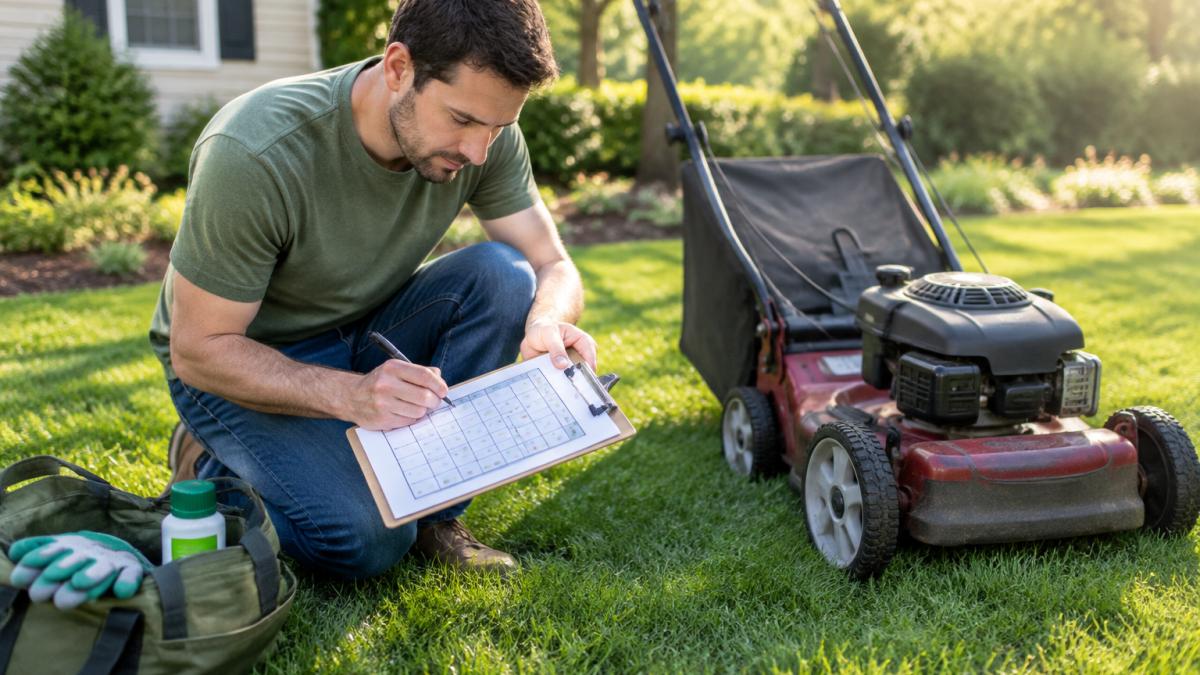
Start with a rake, not a spreader. Clear winter debris so air and light reach the soil. Then pull a soil test before you buy anything.
Set your mower high for the first cut, never scalp a lawn coming out of dormancy. Sharpen the blade before the first mow; a dull blade tears grass and opens the door to disease.
- Frequency: cleanup once, soil test once every 2-3 years, first mow when grass reaches about one-third above your target height.
- Weather trigger: wait until the soil has warmed and the last hard freeze has passed. If a late cold snap is forecast, delay the first mow and skip any pre-emergent until soil temperatures hold steady.
Summer: Mowing Height, Deep Watering, Heat Stress
Mow high (3 to 4 inches for most cool-season grasses) and mow often enough that you remove no more than one-third of the blade. Taller grass shades soil, holds moisture, and crowds out weeds.
Water deeply once or twice a week instead of lightly every day. Aim for about one inch per week, including rainfall, delivered in the early morning.
- Frequency: mow weekly in peak growth, every 10-14 days in slow growth; water 1-2 times weekly.
- Weather trigger: during a drought or heat wave, raise the mowing height by half an inch and water in the early morning to reduce evaporation. After heavy rain, skip the scheduled watering and check for runoff before restarting.
Fall and Winter: Overseeding, Aeration, Protection
Fall is the highest-value season for most lawns. Aerate to relieve soil compaction, then overseed so new grass has warm soil and cool air. Keep leaves off new seed.
- Frequency: aerate and overseed once in early fall; final feed once while grass is still growing; winter protection once.
- Weather trigger: overseed when soil is warm but air is cooling and rain is reliable. If fall is unusually dry, water new seed lightly and often until it establishes. Delay winterizing feed if growth has already stopped.
If you want the work handled, you can review aeration and overseeding service details before booking the fall window.
Watch out: treating this calendar as universal is the most common mistake.
Match the Calendar to Your Grass: Cool-Season vs Warm-Season Timing
Cool-season grass peaks in spring and fall. Warm-season grass peaks in summer. Same calendar, shifted by about six weeks.
| Task | Cool-Season Grass | Warm-Season Grass |
|---|---|---|
| Main feeding window | Early fall, late spring | Late spring, early summer |
| Best overseeding time | Early fall | Late spring to early summer |
| Mowing height | 3-4 inches | 1.5-2.5 inches |
| Peak growth | Spring and fall | Summer |
| Drought strategy | Water deeper, mow higher | Water deeply, avoid summer feeding |
Get this wrong and you fight your own lawn all year. Northern Virginia sits in the transition zone, so many yards are a mix of both types. Match each zone of the yard to its grass.
Your Do It Yourself Lawn Care Schedule: A Step-by-Step Setup
A do it yourself lawn care schedule works if you build it around your actual yard, not a generic chart. The goal is a reusable system, a checklist with task frequency and weather-based triggers, so you are not re-deciding every task from scratch each month. Four steps get you there in one weekend.
Step 1: Audit What You Already Do
Write down what you did last year and when. Note the brown patches, the soggy spots, and the weeds that keep coming back. This audit is the first planning step recommended in Sunday's lawn care planning guide, and it is the step most people skip. Add one column for what the weather was doing at the time, a dry spring or a wet fall explains more than the product label does.
Step 2: Set Goals and Pick Your Non-Negotiables
Pick two or three jobs you will not skip. For most yards that means fall aeration, deep watering, and mowing height. Everything else is optional. Write each non-negotiable as a trigger, not a date, for example, "aerate when soil is moist and grass is actively growing in early fall" rather than "aerate September 15."
- Soil test completed
- Mowing height set on the mower deck
- Watering day chosen, with a rain gauge on the lawn
Step 3: Inspect Irrigation and Fix Coverage Gaps
Run each zone and watch where water lands. Look for tilted heads, clogged nozzles, and dry corners. Fix coverage before you change the timer. A system that misses a corner wastes water everywhere else. Place a few straight-sided cans across one zone and run it for 15 minutes to measure how much each spot receives; adjust heads and run times until the spread is even.
Step 4: Build the Reusable Checklist
Turn the audit and goals into a one-page checklist with four columns: task, frequency, weather trigger, and done. Keep it where you will see it, a spreadsheet, a paper calendar, or a note on the fridge. Review it monthly and after any unusual weather event, and move tasks when the trigger has not been met. This is the difference between a schedule you keep and a chart you abandon by July.
Watch out: a checklist that lists dates without triggers breaks the first time the season runs early or late. If the trigger has not happened, soil still cold, rain still absent, postpone the task rather than forcing it onto the calendar.
Use a Lawn Maintenance Schedule Template to Stay on Track
A lawn maintenance schedule template turns good intentions into a repeatable routine. Keep it simple: month, task, done, notes. A spreadsheet or paper calendar works fine.
| Month | Main Task | Frequency | Watch For |
|---|---|---|---|
| March | Cleanup and soil test | Once | Thatch and debris |
| April | First mow, set height | Weekly | Scalping |
| May | Weed prevention | Once | Crabgrass |
| June | Deep watering | 1-2x weekly | Heat stress |
| July | Pest monitoring | Weekly | Grubs, disease |
| August | Lawn repair | As needed | Drought damage |
| September | Aeration and overseed | Once | Soil compaction |
| October | Final feed | Once | Leaf cover |
| November | Winter protection | Once | Frozen turf |
Print it, stick it on the fridge, and check it monthly.
When a Lawn Care Schedule App Makes Sense (and When It Doesn't)
A lawn care schedule app can help if you enjoy tracking treatments and want reminders. It does not help if you want the work done. Lawn care apps can plan and log treatments for do-it-yourselfers, but you still mow, water, and spread.
Skip the app if your problem is time, not information. Software does not fix a missed aeration window.
Lower-Input, Eco-Friendly Scheduling That Still Delivers a Greener Yard
Fewer treatments, timed correctly, usually beat a heavy product routine. The EPA's guidance on environmentally friendly lawn care recommends minimizing pesticide use, and a healthy, well-timed lawn needs less of it.
Cut Treatments the Lawn Doesn't Need
Most yards get fed and sprayed on a company's schedule, not the lawn's. Skip blanket weed-and-feed. Spot-treat weeds, test soil before fertilizing, and let dense grass crowd out weeds naturally.
Water Conservation and Irrigation Efficiency
Water in the early morning, water deep, and adjust for rainfall. Fix leaks and misaimed heads. A rain sensor and a monthly coverage check save water and money without hurting the lawn.
If you want to understand the wider case for this approach, read the benefits of eco-friendly yard maintenance before switching to a lower-input plan.
Hand the Schedule to a Pro: Booking Your First Seasonal Visit
Handing off the calendar makes sense when your schedule is the reason the lawn slips.
Lover's Lawn Services LLC takes a Scandinavian-inspired approach to lawn care, using eco-friendly practices and state-of-the-art equipment, and offers a 100% satisfaction guarantee with a 3-day refund policy.
Not sure it is worth it? Read how to decide if professional lawn care is worth it, or go straight to the 5 steps to get an instant lawn care quote and get a number this week.
Your lawn will not fix itself by August. The brown patches you see now were decided by what did or did not happen in September.
Frequently Asked Questions
What is a good lawn maintenance schedule?
A good schedule follows the seasons and your grass type rather than a fixed product routine. Start with a spring cleanup and soil test, mow at the right height through summer, water deeply about one inch per week including rainfall, then overseed and aerate in fall. Write each task into a month by month lawn care calendar so nothing gets skipped, and adjust timing when weather conditions shift.
How often should you mow, water, and fertilize your lawn?
Mow often enough that you never remove more than a third of the grass height at once, which usually means weekly during active growth. Water deeply once or twice a week rather than lightly every day, aiming for about one inch per week from irrigation and rainfall combined. Fertilize based on a soil test and your grass type, typically a few times a year rather than monthly, so you are not feeding a lawn that does not need it.
Is there an app or template for scheduling lawn care?
Both exist. A lawn maintenance schedule template, whether printed or a shared spreadsheet, works well for most homeowners because it is simple and visible. A lawn care schedule app adds reminders and treatment tracking, and some DIY-focused apps build personalized plans. If you would rather not manage any of it, a professional service keeps the calendar for you and shows up on a consistent schedule.
How can eco-friendly maintenance still give me a greener yard?
Eco-friendly lawn care leans on timing and soil health instead of constant chemical applications. Aerating to reduce soil compaction, mowing at the correct height, leaving grass clippings to return nutrients, and watering deeply all support stronger root growth. The U.S. Environmental Protection Agency recommends minimizing pesticide use, and a schedule built around prevention and healthy soil typically needs fewer treatments, not more.