 How-to
Sustainable Lawn Care Tips 2026: A Practical Homeowner Guide
Last Updated: November 15, 2026
Quick Summary
Sustainable lawn care starts with a soil test and a lawn calendar matched to your grass type, then builds on deep, infrequent watering, high mowing, core aeration, and natural weed control. Feed the soil with compost and clippings so a thick lawn crowds out weeds without wasting water or inputs.
- Test your soil before buying lime or fertilizer so you know what the lawn actually needs.
- Water only the shortfall below about one inch weekly, counting rainfall, in one or two long morning runs.
- Keep cool-season grass around three to three-and-a-half inches tall and remove no more than one-third of blade height.
- Core aeration works best for most home lawns; spike aeration can add to compaction over time.
- Leave grass clippings on the lawn to return nitrogen and organic matter to the soil.
Table of Contents
- Start With a Soil Test and a Realistic Lawn Calendar
- Water-Saving Lawn Care That Matches Your Grass and Rainfall
- Sustainable Lawn Mowing Practices for a Healthier Cut
- Lawn Aeration Methods That Relieve Compaction Without Damaging Turf
- Natural Weed Control for Lawns: Prevention Before Pulling
- Feed the Soil, Not Just the Grass: Compost, Clippings, and Mulch
- Book Your Sustainable Lawn Care Assessment
- Frequently Asked Questions
Start With a Soil Test and a Realistic Lawn Calendar
Sustainable lawn care starts with two things most homeowners skip: a soil test and a calendar that matches your grass type. This guide walks through the practical steps, from soil health to water savings, that keep a lawn thick without wasting resources.
A soil test tells you what your lawn actually needs. Skip it, and you're guessing on lime, fertilizer, and pH.
Pair that test with a lawn calendar built around your grass. Cool-season grasses such as tall fescue do best with fall feeding and spring seeding. Warm-season grasses wake up later and want their nutrients in late spring.
Here's the basic sequence for a new season:
- Test the soil before you buy anything.
- Note your grass type and your local climate.
- Set mowing, watering, and feeding dates around that grass type.
- Adjust the plan as rainfall and seasonal conditions change.
For a deeper look at the whole approach, see the homeowner's guide to sustainable lawn care practices.
Water-Saving Lawn Care That Matches Your Grass and Rainfall
Water-saving lawn care means watering deeply and less often, then letting rainfall do the rest. Deep watering pushes roots down. Shallow, daily sprinkling keeps roots near the surface, where heat and dry spells hurt them most. Deeper watering encourages deeper roots, which can ride out dry spells with less supplemental water.
Match the schedule to your grass type
Cool-season grasses such as tall fescue and Kentucky bluegrass green up in spring and fall and go semi-dormant in summer heat. They need the most water in late spring and early summer, and they can often survive a summer dry spell on rainfall alone if you let them go dormant rather than propping them up with daily sprinkling. Warm-season grasses such as bermudagrass, zoysia, and buffalograss are more drought-tolerant and typically need less supplemental water once established; overwatering them in spring is a common way to invite disease and shallow roots.
Match the schedule to your rainfall
A fixed timer ignores the weather. A smart controller with a rain sensor or a local evapotranspiration (ET) feed skips cycles after rain and stretches run times when conditions are dry. Check whether your state extension service or local water utility publishes watering recommendations or offers rebates on smart controllers and rain sensors before buying.
A practical weekly routine:
- Check a rain gauge or a straight-sided can on the lawn after each storm.
- Subtract that rainfall from your weekly target (about one inch for most lawns, counting rain).
- Water only the shortfall, in one or two long runs, early in the morning.
- Skip the cycle entirely if the gauge already shows an inch.
Cut evaporation and runoff
Water early in the morning. Early-morning watering cuts evaporation and gives blades time to dry before evening, which lowers disease pressure. Water in longer, less frequent runs so the soil absorbs what you apply; short cycles on a slope mostly run off into storm drains, carrying nutrients with them. A rain barrel catches roof runoff for beds and dry spots, and a simple rain gauge or a tuna can on the lawn tells you what actually landed.
Watch out: watering at night leaves blades wet for hours and invites fungus, and watering a slope in short bursts sends most of the water into the street rather than the root zone.
What the savings look like
You do not need a lab to see the effect. Track your controller's run time and your water bill for one season before and after switching to rain-skipping, deep-and-infrequent watering. Some homeowners notice lower summer irrigation run time once the controller skips watering after rain. Pair that with a rain barrel for beds and you cut both municipal water use and the runoff that carries fertilizer into local waterways.
Here is the weekly watering routine the article recommends for cutting water use without starving the lawn.
| Step | What to do | Frequency |
|---|---|---|
| 1 | Check a rain gauge or straight-sided can after each storm | After every storm |
| 2 | Subtract rainfall from weekly target of about one inch | Weekly |
| 3 | Water only the shortfall in one or two long runs | Weekly, early morning |
| 4 | Skip the cycle if the gauge already shows an inch | As needed |
Sustainable Lawn Mowing Practices for a Healthier Cut
Sustainable lawn mowing practices come down to three rules: cut high, cut often, and leave the clippings. Taller blades shade the soil, crowd out weeds, and hold moisture better than a scalped lawn.
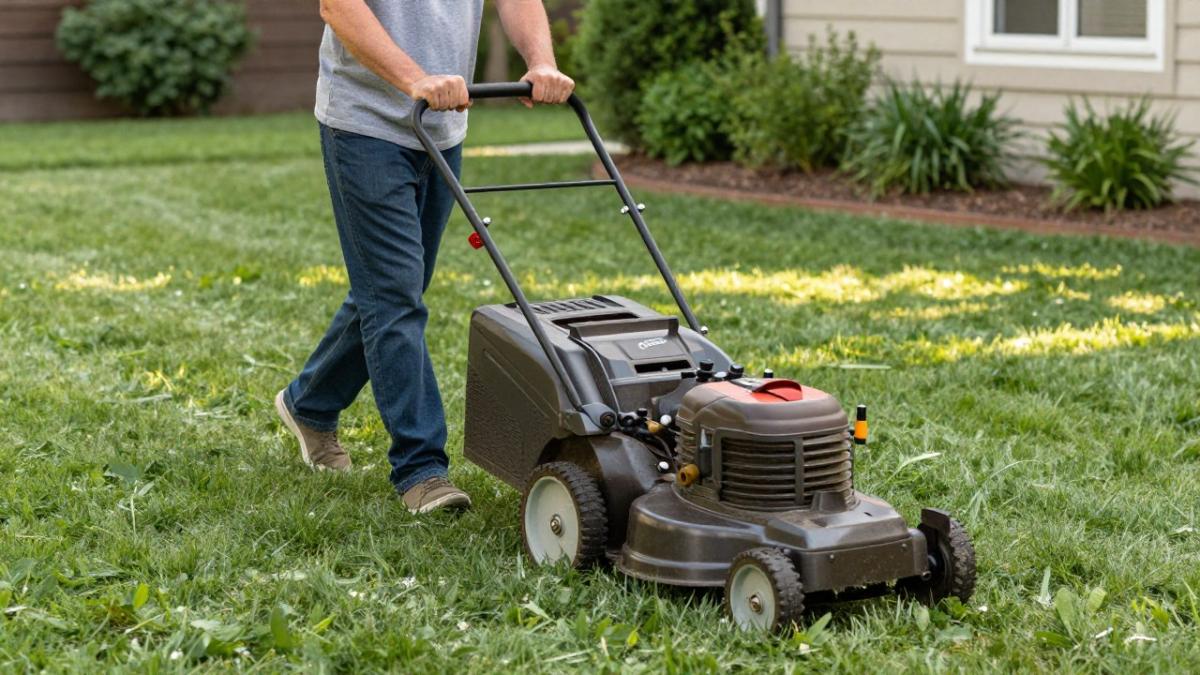
Set the deck so you remove no more than one-third of the blade height at a time. For most cool-season lawns, that means keeping grass around three to three-and-a-half inches tall. Sharp blades matter as much as height.
Grasscycling, or leaving grass clippings on the lawn, returns nitrogen and organic matter to the soil. Clippings break down fast and do not cause thatch when you mow regularly.
Lawn Aeration Methods That Relieve Compaction Without Damaging Turf
Lawn aeration methods loosen compacted soil so air, water, and nutrients reach the roots. Core aeration, which pulls small plugs of soil, works best for most home lawns. Spike aeration just pokes holes and can add to compaction over time.
Aerate when the grass is actively growing. For cool-season lawns, that's early fall. For warm-season grasses, late spring or early summer. Water lightly the day before so plugs pull cleanly, and stay off the lawn until the holes close.
Signs you need it:
- Water puddles and runs off instead of soaking in.
- The soil feels hard when you push a screwdriver in.
- Thatch is thick and roots sit shallow.
Aeration pairs well with overseeding and compost topdressing.
Natural Weed Control for Lawns: Prevention Before Pulling
Natural weed control for lawns starts with prevention, not pulling. A thick, well-fed lawn crowds out weeds before they get a foothold. Fix bare spots, mow high, and water correctly, and you remove most of what weeds need. The stronger approach is integrated pest management (IPM): identify the weed, set a threshold for when it actually matters, and choose the least disruptive control that fits.
Step 1: Identify before you treat
Different weeds signal different problems. Dandelions and plantain often point to thin turf and compacted soil; crabgrass and goosegrass point to bare spots and mowing too short; moss points to shade, poor drainage, or low pH. A soil test and a close look at where the weed grows tell you whether the fix is cultural (better mowing, aeration, overseeding) or a targeted product. Treating a symptom without fixing the cause just brings the weed back.
Step 2: Set an action threshold
IPM means deciding in advance how much weed pressure you will tolerate before acting. A few dandelions in a back corner may not be worth any product; a spreading patch of crabgrass in a high-traffic area is. Walk the lawn monthly during the growing season, note the weed species and roughly how much ground they cover, and treat only when the patch crosses your threshold. This keeps you from blanket-spraying a lawn that mostly needs better culture.
Step 3: Prevention first
- Mow high and often so turf shades the soil.
- Overseed thin areas in the right season for your grass type.
- Aerate compacted soil so water and nutrients reach roots.
- Fix drainage and shade problems that favor moss and damp-loving weeds.
- Keep mower blades sharp so grass recovers and fills gaps.
Step 4: Least-disruptive control
For existing weeds, hand-pull small patches before they seed, and pull after rain when soil is soft. For broadleaf weeds, spot-treat rather than blanket-spray, and choose organic products labeled for lawns. Corn gluten meal is a common organic pre-emergent option, though timing matters and results vary.
Protect pollinators and prevent runoff
Pollinator-safe weed control is mostly about timing and restraint. Avoid spraying blooming weeds, mow before you treat so flowers are gone, and spray on a calm morning when bees are less active. Read the label and follow it exactly for safety and correct application: the label sets the rate, the timing, and the conditions under which the product should not be used.
Watch out: applying a pre-emergent after weed seeds have already sprouted wastes the product and can still leave you with a full crop of crabgrass, and spraying blooming clover or dandelions during the day is one of the most common ways homeowners harm pollinators.
For a full walkthrough, read the how-to guide to organic weed control for residential lawns.
Feed the Soil, Not Just the Grass: Compost, Clippings, and Mulch
Feeding the soil is the core of eco-friendly lawn care. Compost adds organic matter and slow-release nutrients. Grass clippings return nitrogen. Mulch holds moisture and keeps soil temperature steady.
Spread a thin layer of compost in fall or spring, and let clippings stay put after mowing. Mulch beds and tree rings to cut evaporation and suppress weeds. If your soil test shows low pH, liming corrects it so nutrients become available. For beds and borders, professional mulching keeps the layer even and tidy.
A simple feeding plan:
- Compost once or twice a year.
- Leave clippings after every mow.
- Mulch beds to hold moisture.
- Retest soil every few years.
Book Your Sustainable Lawn Care Assessment
A healthy, resilient lawn comes from the right steps in the right order: soil test, smart watering, high mowing, aeration, natural weed control, and feeding the soil.
If you'd rather hand it off, Lover's Lawn Services LLC brings a calm, Scandinavian-inspired approach to eco-friendly lawn care. We use state-of-the-art equipment and offer a 100% satisfaction guarantee with a 3-day refund policy. We have served 500+ local homes with a 4.9/5 Google rating. Have questions first? See our frequently asked questions.
Ready to stop guessing and start with a plan built for your grass, your soil, and your schedule? Get started with Lover's Lawn Services LLC and book a sustainable lawn care assessment for a greener, healthier yard year-round.
Frequently Asked Questions
What is the most sustainable way to care for a lawn?
Start with a soil test, then water deeply and infrequently, mow high, and return grass clippings to the turf. Add compost once a year, aerate when the soil compacts, and use mulch or dense seeding to crowd out weeds. Sustainable lawn care works because it builds soil health and deeper roots, which makes the lawn more resilient through heat and dry spells. A simple lawn calendar keeps these steps on schedule instead of relying on chemical fixes.
How often should you water a lawn to conserve water?
Water when the grass tells you it needs it, usually when the top inch of soil dries out and footprints stay visible. One deep watering of about an inch per week, delivered in the early morning, beats several light sprinklings. Early-morning watering reduces evaporation and runoff, and a rain barrel or smart irrigation schedule helps you skip watering after rainfall. Adjust the schedule as seasonal conditions change.
How can you control weeds in a lawn naturally?
Natural weed control for lawns focuses on prevention: mow at the right height, overseed bare patches, and keep the soil healthy so turf crowds out weeds. Hand-pull small infestations before they seed, and use corn gluten meal as a pre-emergent option where appropriate. Spot-treat stubborn weeds rather than broadcasting herbicide. Thick, resilient turf is the most reliable long-term weed strategy.
When should you aerate your lawn?
Aerate during the grass's active growing season, typically early fall for cool-season grasses and late spring for warm-season types. Core aeration, which pulls small plugs of soil, relieves compaction and improves water and nutrient uptake. Avoid aerating when the soil is bone dry or waterlogged. If thatch is thicker than about half an inch, pair aeration with dethatching for better results.