 ultimate-guide
Sustainable Lawn Maintenance for Commercial Properties
Last Updated: October 23, 2026
Quick Summary
Sustainable lawn maintenance for commercial properties manages outdoor landscapes to reduce environmental impact while maintaining aesthetic and functional value, prioritizing resource efficiency, biodiversity, and long-term property health. It combines smart irrigation, native plants, and organic soil management to cut water use by 30-50%, reduce chemical inputs, and lower operating costs measurably within the first two seasons.
- Efficient irrigation systems cut water use by 30-50% on commercial properties.
- Native plants require less fertilizer and water than non-native ornamentals.
- Integrated Pest Management reduces chemical use by 70-90% while maintaining turf quality.
- Water consumption typically declines within the first season after irrigation upgrades.
- Soil health improvements reduce pest and disease pressure over time.
Table of Contents
- What Sustainable Lawn Maintenance for Commercial Properties Means
- Water-Efficient Commercial Landscaping: Reduce Use, Save Money
- Native Plants for Commercial Landscapes: Lower Maintenance, Better Outcomes
- Building Your Commercial Landscape Maintenance Plan
- Organic Lawn Care for Businesses: Eliminating Chemical Inputs
- Implementation Steps and Contractor Oversight
- Frequently Asked Questions
What Sustainable Lawn Maintenance for Commercial Properties Means
Sustainable lawn maintenance for commercial properties manages outdoor landscapes to reduce environmental impact while maintaining aesthetic and functional value.
The commercial landscaping industry represents a significant portion of the broader market. According to IBISWorld's 2026 landscaping analysis, the landscaping services industry encompasses 556,000 businesses and generates $176.7 billion annually.
What separates sustainable lawn maintenance from conventional approaches is measurable outcomes. Native plants require less fertilizer and water. Efficient irrigation systems cut water use by 30-50%.
The real difference is a shift in thinking.
Water-Efficient Commercial Landscaping: Reduce Use, Save Money
Water consumption represents one of the largest controllable costs in commercial landscape management. Reducing water use without sacrificing property appearance requires a strategic approach combining smart irrigation technology, landscape design, and maintenance practices.
Smart Irrigation Systems and Scheduling
Modern irrigation systems use soil moisture sensors, weather data, and zone-based controls to deliver water only when and where it's needed.
The EPA's greener landscaping guidance identifies efficient irrigation as a core sustainability consideration for commercial properties.
Scheduling precision matters as much as technology. Most commercial properties over-irrigate significantly. Reducing irrigation cycles by 20-30% while maintaining turf quality is achievable on most properties without visible decline.
Rainwater Management and Stormwater Solutions
Capturing and using rainwater reduces dependence on municipal supply and addresses stormwater management requirements that increasingly burden commercial properties. Rain gardens, permeable paving, and retention basins reduce water consumption while complying with local stormwater regulations.
Rain gardens planted with native species filter runoff while creating habitat. Permeable pavers allow water infiltration rather than surface runoff. These solutions reduce irrigation demand, lower the property's environmental footprint, and often improve compliance with local water management codes.
Native Plants for Commercial Landscapes: Lower Maintenance, Better Outcomes
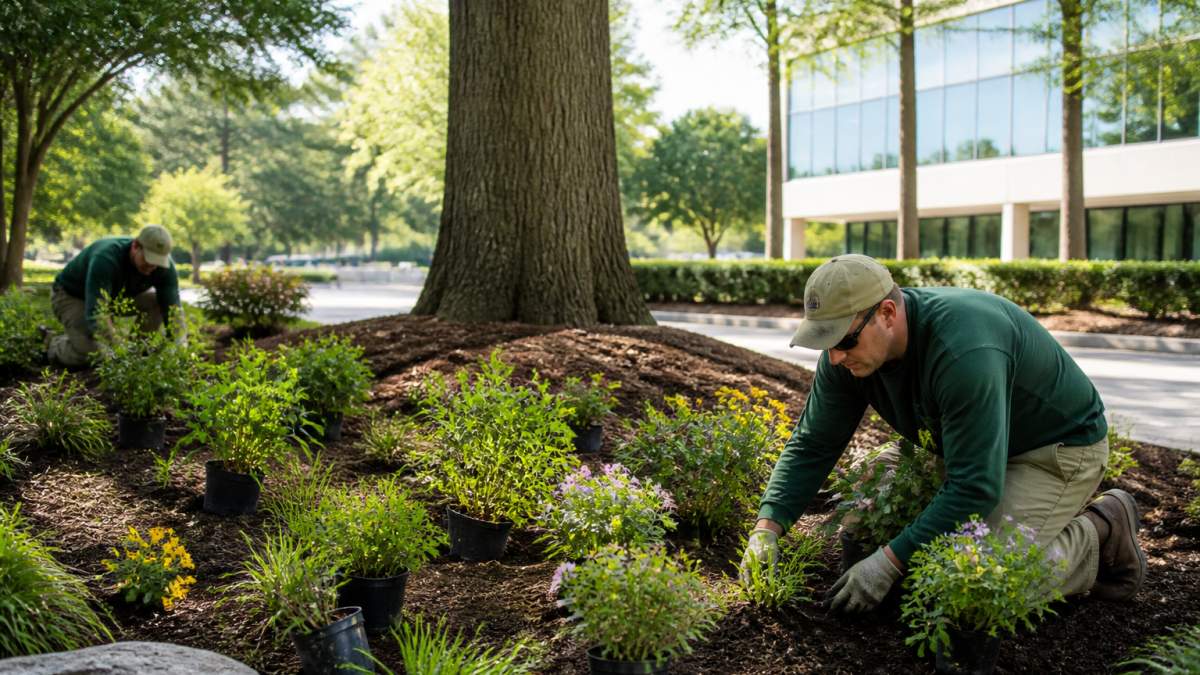
Native plants are species naturally occurring in your region's climate and soil conditions.
Native species selection depends on your location, light exposure, and soil type. A landscape architect or horticulturist can identify native alternatives to conventional ornamentals that match your aesthetic requirements.
Establishing native plantings requires upfront investment in site preparation and plant selection, but maintenance costs drop substantially within two years. Native plants tolerate local pests and diseases better than imports, establish deeper root systems that improve drought tolerance, and require less supplemental fertilizer because they're adapted to local soil chemistry.
Building Your Commercial Landscape Maintenance Plan
A comprehensive maintenance plan translates sustainability principles into a property-specific operating calendar with measurable targets. Generic seasonal advice fails because an office park, a retail center, and an industrial site have different traffic patterns, visibility requirements, and risk profiles. Build the plan around your property type, climate zone, and reporting obligations.
A Property-Type-Specific Seasonal Calendar
The following calendar assumes a temperate climate with four distinct seasons. Adjust timing by two to four weeks based on your USDA Plant Hardiness Zone and local frost dates.
Office parks and corporate campuses. These properties prioritize curb appeal and tenant experience.
Retail sites. Visibility, parking-lot islands, and signage sightlines drive maintenance priorities.
Industrial properties. Safety, access, and low-maintenance buffers matter more than ornamental precision.
Measurable Benchmarks and Reporting
A maintenance plan without metrics is just a task list. Establish baseline metrics before transition begins and track them quarterly. Practical KPIs include:
- Water use: gallons per irrigated acre per month, compared with the prior year and with a local evapotranspiration-based target.
- Chemical use: pounds of active ingredient per acre per year for fertilizer and pesticides, tracked separately.
- Turf condition: a simple 1-to-5 visual rating by zone, recorded during routine inspections.
These metrics let you compare properties, justify budget requests, and demonstrate progress to ownership or tenants. Typically, water use declines within the first season, chemical use declines in year two as soil health improves, and labor hours stabilize as landscapes mature.
Budgeting for Transition and Long-Term Savings
Transitioning to sustainable maintenance requires upfront investment in soil amendment, native plantings, and irrigation controls. Allocate a portion of annual landscape spending to transition improvements and phase the work over two to three years: year one on soil health and irrigation upgrades, year two on native plantings and refined organic practices, year three on refining management based on two seasons of data.
Long-term budgets should reflect lower operating costs. Most practitioners find water consumption drops meaningfully after irrigation upgrades and plant establishment, and fertilizer applications decrease as soil biology improves. Build your budget on your own baseline metrics and adjust annually.
Organic Lawn Care for Businesses: Eliminating Chemical Inputs
Organic lawn care relies on biological processes and mechanical methods rather than synthetic pesticides and fertilizers. It builds soil health, reduces environmental contamination, and often improves long-term turf quality compared to chemical-dependent management.
Soil Health and Integrated Pest Management
Healthy soil is the foundation of organic lawn care. Soil rich in organic matter and beneficial microbes suppresses disease naturally, supports turf vigor, and reduces pest pressure.
Integrated Pest Management (IPM) uses monitoring, cultural practices, and targeted intervention to manage pests below economically damaging thresholds (the EPA). Rather than spraying preventively, IPM practitioners scout regularly, identify pests accurately, and apply treatments only when populations warrant action.
Reducing Fertilizer and Pesticide Dependency
Most commercial landscapes are over-fertilized and over-treated. Soil testing reveals actual nutrient needs rather than standard rates. Organic fertilizers release nutrients slowly, reducing leaching and runoff, and applying only what plants need reduces environmental impact and cost.
Pest management without synthetic chemicals requires accepting minor cosmetic damage. Lawns don't need perfection. A few broadleaf weeds or minor insect damage is acceptable if it means eliminating chemical inputs.
Implementation Steps and Contractor Oversight
Successful transition to sustainable lawn maintenance requires careful contractor selection and ongoing performance monitoring. The right partner understands both the environmental principles and the practical business case. Use this procurement checklist, service-level expectations, and reporting mechanics to put recommendations into practice.
Selecting the Right Landscape Partner
Your landscape contractor should demonstrate knowledge of local native plants, soil science, and sustainable practices, and be able to explain their approach, not just execute tasks. Ask these questions during procurement:
- Can you provide soil test results and recommendations for our property before we sign a contract?
- How do you schedule irrigation, and what technology do you use to adjust for weather and soil moisture?
- What is your approach to pest management, and at what thresholds do you intervene?
Request documentation of past outcomes, such as water savings, cost reductions, or turf quality improvements. Sustainable practices should deliver results you can verify, not just promises. At Lover's Lawn Services LLC, we back our work with a 100% satisfaction guarantee and 3-day refund policy.
Service-Level Expectations
Define service levels in writing so both parties share the same expectations. A practical service-level agreement for sustainable maintenance includes:
- Mowing: frequency by season, height range for your turf species, and clipping management.
- Irrigation: inspection frequency, response time for leaks or broken heads, and seasonal scheduling adjustments.
- Pest and disease scouting: weekly or biweekly monitoring during the growing season, with written reports.
Measuring Performance and Reporting Results
Establish baseline metrics before transition begins: current water consumption, maintenance labor hours, fertilizer and pesticide spending, and turf quality assessment. Track them quarterly and annually.
Regular quarterly reporting on water use, cost trends, and landscape health keeps everyone aligned on progress. This transparency demonstrates that sustainable practices deliver business value, not just environmental benefit, and gives you documentation for budget reviews and tenant communications.
Frequently Asked Questions
What does sustainable lawn maintenance for commercial properties involve?
Sustainable lawn maintenance combines water conservation, reduced chemical inputs, native plant selection, and soil health management. Property managers implement efficient irrigation systems, eliminate or minimize fertilizers and pesticides, choose drought-tolerant and native plants suited to local conditions, and adopt integrated pest management practices. The goal is to maintain attractive, functional outdoor spaces while reducing resource consumption, operational costs, and environmental impact. This approach typically improves property value and aligns with ESG goals.
How can commercial properties reduce water use in lawn care?
Install smart irrigation systems that adjust watering based on rainfall, soil moisture, and weather forecasts. Schedule irrigation for early morning or evening to minimize evaporation. Group plants by water needs and use mulch to retain moisture. Incorporate rainwater harvesting or bioswales to capture runoff. Replace turf in low-traffic areas with native groundcovers or hardscape. The EPA identifies native and climate-appropriate plants and low- or zero-input approaches as key water conservation strategies in commercial landscaping.
What are the best eco-friendly alternatives to chemical lawn treatments?
Use organic fertilizers derived from plant or animal materials, compost applications to build soil health, and aeration to improve nutrient uptake. For pest control, employ integrated pest management: introduce beneficial insects, use targeted organic sprays only when thresholds are exceeded, and remove affected plants promptly. Mechanical weed control and hand-pulling reduce herbicide need. Soil testing identifies actual nutrient deficiencies, preventing unnecessary applications. These methods improve long-term turf resilience while eliminating toxic residues.
How often should commercial lawns be mowed?
Mow when grass reaches one-third taller than the desired height, typically every 7-14 days during active growing season. Avoid cutting more than one-third of the blade in a single mow, which stresses turf and invites weeds and disease. Adjust frequency based on rainfall and growth rate; drought stress may reduce mowing needs. Mulching mowers return clippings to feed soil, reducing fertilizer requirements. Electric equipment produces zero emissions and significantly less noise than gas alternatives, benefiting tenants and the environment.
Does sustainable landscaping reduce commercial property maintenance costs?
Yes. Native and drought-tolerant plants require less water, fertilizer, and pest treatment over time. Efficient irrigation systems cut water bills; reduced chemical inputs lower material and application costs. Improved soil health reduces disease and pest pressure, decreasing emergency treatments. However, transition costs exist: soil amendments, plant replacement, and system installation require upfront investment. Over 3-5 years, most properties see cumulative savings that exceed initial outlays. A detailed maintenance plan and budget forecast help property managers understand true cost of ownership.
What native plants are suitable for commercial landscapes?
Native plant selection depends on your region and site conditions. Choose species suited to local soil, sunlight, and moisture availability. Examples include native grasses, flowering perennials, shrubs, and trees that support local pollinators and wildlife. Native plants typically require less water, fertilizer, and pesticide than non-native ornamentals once established. They also enhance biodiversity and landscape appeal. Consult local horticultural extension services or landscape professionals familiar with regional native species to ensure proper selection and placement for your property type.
How can property managers create a sustainable commercial landscaping plan?
Start with a site audit: assess current water use, chemical inputs, plant health, and soil condition. Set goals for water reduction, cost savings, and environmental outcomes. Prioritize quick wins (irrigation upgrades, mulching) and longer-term changes (plant replacement, soil building). Establish a seasonal maintenance calendar with specific tasks and responsible parties. Budget for transition and ongoing care. Select a contractor experienced in sustainable practices and able to provide performance reporting. Review and adjust the plan annually based on results and changing site conditions.
How can commercial properties manage stormwater sustainably?
Use bioswales, rain gardens, and permeable hardscape to capture and filter runoff on-site rather than directing it to storm drains. Native plants in these features slow water movement, allowing infiltration and reducing flooding risk. Mulched planting beds and healthy soil increase water absorption. Grade landscapes to direct runoff toward vegetation rather than pavement. These practices reduce stormwater pollution, recharge groundwater, and lower municipal stormwater fees. They also create habitat for pollinators and improve landscape resilience during heavy rain events.