 Comparison
Groundskeeping vs Property Management for Commercial Sites
Last Updated: November 6, 2026
Quick Summary
Groundskeeping vs property management comes down to physical work versus business oversight: groundskeeping crews handle mowing, pruning, irrigation, weed control, and seasonal cleanup, while property management oversees vendor contracts, budgets, tenant relations, and compliance. The party paying for the service owns the contract, so property managers usually hold the grounds contract and enforce quality standards.
- The U.S. landscaping services industry counts 692,777 businesses, a 4.8% increase from 2024.
- Property managers rarely mow anything but own every outcome the mowing produces.
- Write service-level agreements with measurable standards like mowing height and visit frequency.
- Bundled arrangements offer one invoice but less visibility into line-item grounds costs.
- Build grounds budgets in layers, including event-driven work like snow and storm cleanup.
Table of Contents
- Groundskeeping vs Property Management: The Core Difference
- Commercial Property Management Responsibilities Beyond the Lawn
- What Commercial Grounds Maintenance Services Actually Cover
- Where the Two Roles Overlap and Who Owns the Contract
- Commercial Lawn Care Services and Seasonal Site Care
- What Belongs in a Commercial Landscape Maintenance Contract
- Cost Factors, Budgets, and Total Cost of Ownership
- Which Model Fits Your Property: A Decision Framework
- Frequently Asked Questions
Groundskeeping vs Property Management: The Core Difference
The U.S. landscaping services industry now counts 692,777 businesses, a 4.8% increase from 2024, according to the National Association of Landscape Professionals industry statistics.
**Groundskeeping is the physical care of the outdoor site: mowing, pruning, irrigation, weed control, and seasonal cleanup.
The distinction matters because it decides who signs the maintenance contract and who answers when the lawn looks bad before a tenant tour.
Commercial Property Management Responsibilities Beyond the Lawn
Property management is broader than most vendors realize. The U.S. property management services market is projected to grow from USD 84.73 billion in 2025 to USD 88.07 billion in 2026, according to Mordor Intelligence market research, which tells you how much responsibility now sits with property managers.
Core duties typically include:
- Vendor selection and vetting, including insurance verification and reference checks
- Budget ownership, from annual grounds budgets to capital planning
- Tenant and resident satisfaction, including response times on complaints
For a fuller picture of what professional landscaping providers offer businesses, see our guide to professional landscaping services for businesses. The key point: property managers rarely mow anything, but they own every outcome the mowing produces.
What Commercial Grounds Maintenance Services Actually Cover
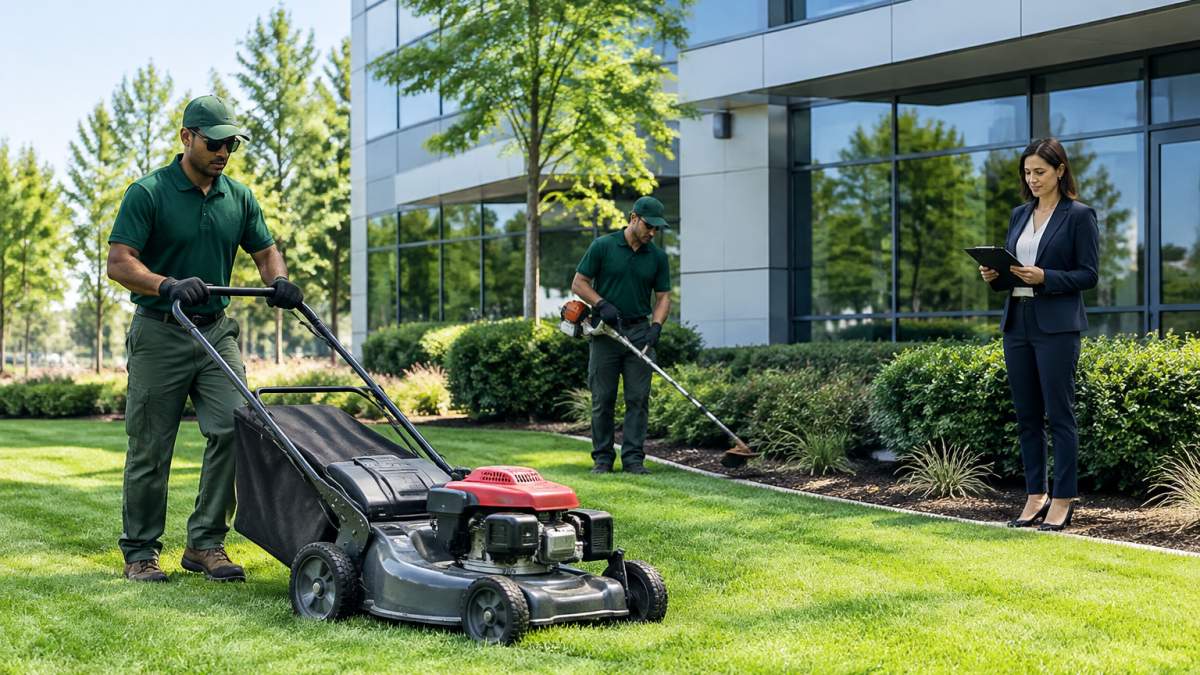
Commercial grounds maintenance services cover the recurring physical work that keeps a site safe, tidy, and presentable. A standard commercial scope usually includes mowing, edging, pruning, bed maintenance, irrigation checks, weed control, fertilization, debris removal, and seasonal care.
Tasks Included in a Standard Scope of Work
A typical commercial scope of work defines:
- Mowing and edging frequency, usually weekly during growing season
- Pruning and shrub care by plant type and season
- Irrigation checks and adjustments
- Weed control and fertilization schedules
- Debris and leaf removal after storms and in fall
- Seasonal color and mulch refresh
If you want a practical way to define and verify this list, our commercial landscaping checklist walks through each task. Vague scopes are the number one source of disputes, so write every task down.
Where the Two Roles Overlap and Who Owns the Contract
The overlap is real but narrow. Groundskeeping providers report on site conditions; property managers decide what to do about them.
In most commercial arrangements, the property manager or property owner holds the landscape maintenance contract, even when a separate facility team coordinates day-to-day service.
United Land Services frames the in-house versus outsourced decision as a cost-and-quality trade-off that depends on property profiles, per their comparison of in-house and outsourced landscape maintenance.
Commercial Lawn Care Services and Seasonal Site Care
Commercial lawn care services differ from residential work in frequency, equipment, and documentation, as commercial properties usually need fixed schedules, larger equipment, and written service records. Seasonal care adds another layer: spring cleanup, summer irrigation management, fall leaf removal, and winter ice management.
Snow removal and ice management deserve their own line in any commercial agreement. If you want to explore service options that match seasonal site care, you can review seasonal lawn care offerings.
| Service | Typical Frequency | Who Oversees |
|---|---|---|
| Mowing and edging | Weekly in season | Grounds crew |
| Irrigation checks | Monthly in season | Grounds crew |
| Fertilization and weed control | Seasonal rounds | Grounds crew |
| Snow and ice management | Per event | Property manager dispatch |
| Quality inspections | Monthly | Property manager |
What Belongs in a Commercial Landscape Maintenance Contract
A commercial landscape maintenance contract should define scope, schedule, pricing, response times, and termination terms in writing. The contract is where groundskeeping and property management responsibilities meet, so ambiguity costs money on both sides. Disputes that escalate are rarely about the work itself.
Essential elements:
- Scope of work with task-level detail and service frequency
- Service-level agreements with measurable standards
- Pricing structure, fixed monthly or per-service
For practical tips on structuring and negotiating this agreement, read our guide to commercial lawn maintenance contract tips for property managers.
Responsibility Boundaries: Who Owns What
The clearest way to prevent finger-pointing is to write responsibility boundaries into the contract itself. A common pattern assigns each decision to one party:
| Decision or task | Typically owned by | Why it belongs there |
|---|---|---|
| Selecting and vetting the grounds vendor | Property manager or owner | Holds budget authority and insurance verification |
| Approving scope changes and add-on work | Property manager | Controls spend and tenant expectations |
| Day-to-day crew scheduling and crew safety | Groundskeeping provider | Direct employer of labor |
| Reporting site conditions and completed work | Groundskeeping provider | Produces the documentation trail |
| Handling tenant complaints about grounds | Property manager, escalated to vendor | Single point of contact for tenants |
| Liability for missed maintenance | Defined in contract; usually the party that accepted the obligation | Removes ambiguity after an incident |
A frequent failure mode is a contract that names the vendor as responsible for "maintaining the grounds" without defining what happens when a visit is missed, who documents it, and whether the property manager or the vendor absorbs the cost of a re-visit.
Watch out: Contracts that assign liability with vague language like "vendor shall keep grounds in good condition" tend to produce disputes after the first missed visit, because neither party can point to a measurable standard.
Service-Level Agreements and Measurable Standards
Service-level agreements turn vague promises into measurable standards. Instead of "lawns maintained weekly," write "all turf areas mowed to 3 inches every 7 days during growing season, with missed visits credited." Add response-time commitments for complaints and a defined inspection cadence.
A workable SLA usually defines five things:
- Inspection frequency, for example, a documented walk-through after each service visit or a monthly joint inspection with the property manager.
- Response times, a stated window for acknowledging a complaint and a separate window for resolving it.
- Completion standards, measurable outcomes such as mowing height, edging tolerance, bed weed threshold, and debris clearance.
- Reporting, what the vendor submits, how often, and in what format (photo logs, service tickets, exception reports).
- Escalation process, the named contact on each side and the trigger that moves an issue from crew lead to account manager to owner.
Watch out: Contracts that list tasks without frequencies or acceptance criteria are the most common cause of recurring disputes over quality.
Cost Factors, Budgets, and Total Cost of Ownership
Pricing for commercial grounds maintenance depends on property size, site complexity, service frequency, equipment needs, and seasonal demands. Pricing depends on property size, site complexity, service frequency, and equipment needs. For current pricing on our services, check our website.
Total cost of ownership goes beyond the invoice. Factor in:
- Labor and equipment costs, whether in-house or outsourced
- Contract administration time for the property manager
- Rework and complaint handling when quality slips
For concrete benchmarks to build a budget, our 2026 lawn care pricing guide breaks down the cost factors. Property management revenue has grown roughly 3% to 4% annually over the past decade, per TenantCloud property management statistics, so grounds budgets are competing with other rising costs.
Bundled Versus Separate Services: The Trade-Off
One of the biggest cost decisions is whether to bundle groundskeeping under the property management agreement or keep it as a separate contract. The two structures shift cost and control in different directions:
| Structure | What the property manager gains | What it costs |
|---|---|---|
| Bundled into property management | One invoice, one point of contact, less coordination time | Less visibility into line-item grounds costs; markup may be embedded |
| Separate groundskeeping contract | Direct control of scope, pricing, and SLA enforcement | More administration time; property manager owns vendor oversight |
| Hybrid (manager coordinates, owner holds contract) | Budget authority stays with owner; manager handles day-to-day | Requires clear written boundaries to avoid gaps |
A common pattern is that bundled arrangements look cheaper on the invoice but carry hidden coordination and markup costs, while separate contracts look more expensive up front but give the property manager leverage to renegotiate scope. Neither is universally cheaper, the right answer depends on how much oversight capacity the property team actually has.
Building a Grounds Budget: A Practical Framework
Rather than guessing at a single number, build the budget in layers so each cost can be defended during a budget review:
- Base recurring services, mowing, edging, pruning, bed maintenance, and irrigation checks at the contracted frequency.
- Seasonal services, spring cleanup, fall leaf removal, mulch refresh, and seasonal color, priced per round rather than per month.
- Event-driven services, snow and ice management, storm debris removal, and emergency irrigation repairs, budgeted as a contingency rather than a fixed line.
- Administration and oversight, the property manager's time for inspections, complaint handling, and contract enforcement, which is a real cost even when it does not appear on an invoice.
- Contingency, a reserve for rework, missed-visit credits, and scope changes mid-season.
Watch out: Budgets that fund only the base recurring services tend to blow up in the first snow event or storm cleanup, because event-driven work was never assigned a funding line.
Where the Money Actually Goes
In most commercial grounds contracts, labor is the largest cost driver, followed by equipment and materials. That is why two properties of the same size can carry very different prices: one may have steep slopes, tight access, irrigation complexity, or high-visibility turf that requires more frequent visits. When comparing bids, ask each provider to break out labor hours, visit frequency, and material allowances so you are comparing the same scope rather than the same headline number.
Which Model Fits Your Property: A Decision Framework
The right model depends on your property profile, not on a universal rule. Use this framework:
| If your property is... | Recommended model | Why |
|---|---|---|
| Single site, under 2 acres | Outsourced groundskeeping | Lower overhead, fixed pricing |
| Multi-site portfolio | Outsourced with one coordinator | Consistent standards across sites |
| Large campus with dedicated staff | Hybrid in-house plus vendor | Control plus seasonal surge capacity |
| High tenant visibility | Outsourced with SLA reporting | Measurable quality and documentation |
| Budget-constrained | Outsourced basic scope | Predictable monthly cost |
The landscaping industry employs more than 1.4 million people, per NALP industry data, which means qualified crews exist in most markets. The real decision is whether you want to manage people or manage a contract. Most commercial property managers are better served managing a contract.
The hardest part of commercial grounds care is not choosing a mower. It is finding a provider that shows up on schedule and answers when something goes wrong.
Frequently Asked Questions
What is the difference between commercial groundskeeping and property management services?
Groundskeeping covers the physical care of the land: mowing, pruning, irrigation, weed control, fertilization, and debris removal. Property management is the broader oversight role that handles budgets, vendor contracts, tenant relations, and compliance. In practice, a property manager often hires and supervises the groundskeeping vendor, so the two roles work together rather than compete. The property manager owns the contract and the accountability; the grounds crew executes the scope of work on site.
Does property management include lawn and landscape maintenance?
It can, but not always. Some property management firms bundle commercial lawn care services into their service offering, while others coordinate third-party groundskeeping contractors and pass the cost through. Ask any property manager directly whether landscape maintenance is in-house, subcontracted, or excluded from the management agreement. Clarifying this before signing prevents surprise line items and gaps in service frequency during peak growing season.
Who is normally responsible for landscaping at a commercial property?
Responsibility depends on the lease structure. In a triple net lease, the tenant often carries maintenance costs, while in a gross lease the landlord typically does. The property owner or manager usually holds the final accountability for curb appeal and grounds condition, even when a contractor performs the work. Put the responsibility in writing in the commercial landscape maintenance contract so no party assumes someone else is handling mowing, irrigation, or snow removal.
When should a commercial property hire a groundskeeping company?
Hire a dedicated groundskeeping provider when the site has recurring maintenance needs that outstrip staff capacity, when service frequency must be reliable across seasons, or when curb appeal directly affects tenant satisfaction and property value. Multi-site facilities and properties with complex irrigation or snow removal needs benefit most. Compare scope of work, response time, and quality control terms before signing, and confirm the provider carries the insurance and licensing your property requires.
How do commercial groundskeeping services differ from residential lawn care?
Commercial groundskeeping usually involves larger property size, greater site complexity, and stricter documentation. Crews handle multi-site facilities, commercial snow removal and ice management, and service-level agreements with defined response times. Residential lawn care is typically simpler and priced per visit. Commercial work also demands vendor vetting, insurance certificates, and a maintenance schedule tied to facility operations, which is why commercial versus residential pricing and contracts differ so much.